
Image

Otero County New Mexico’s Budget Ticking Time Bomb - 2nd Life Media AlamogordoTownNews.org



The attached document is the certified final budget for Otero County, New Mexico, for Fiscal Year 2025-2026 (FY26), approved by the New Mexico Department of Finance and Administration (DFA) on August 26, 2025, and adopted by the Otero County Commission via Resolution #07-22-25/114-01 on July 22, 2025. This budget represents the county's 114th fiscal year and was developed based on projected needs, with sufficient resources deemed available to cover planned expenditures at the time of approval but now the county faces a budget shortfall that was never planned nor imagined.
The Otero County Commission has been all but silent on what it could face, but the public must begin asking serious questions especially as we log into a primary election season. -FY26 FINAL BUDGET BOOK Otero County.pdf - Google Drive
Key aggregate figures from the DFA Recap (summarized from the provided table on page 8 of the document) across all funds include:
The budget emphasizes public safety, infrastructure, and community services, with significant allocations to:
The budget assumes stable revenue streams from property taxes, gross receipts taxes (GRT), grants, and facilities like the Otero County Processing Center (OCPC, ICE facility) and Otero County Prison Facility (MTC), which contribute to GRT and rent payments.
As of March 10, 2026 (midway through FY26, which runs July 1, 2025–June 30, 2026), no publicly available mid-year financial reports, quarterly statements, or audits specifically detailing FY26 performance were found on the Otero County website, NM DFA site, or State Auditor's Office. The most recent audited financial statements as featured in prior stories raised concerns from the state in oversight and control. This lack of timely audits could indicate administrative delays but does not necessarily signal issues.
Without direct FY26 data, the budget appears to be on track based on the absence of reported variances or adjustments in official sources. However, recent developments suggest emerging pressures that could deviate from the attached projections:
Compared to the attached budget:
The Immigrant Safety Act (House Bill 9), signed into law by Governor Michelle Lujan Grisham on February 5, 2026, and effective May 20, 2026, prohibits New Mexico public bodies from entering into or renewing contracts with U.S. Immigration and Customs Enforcement (ICE) for civil immigration detention. This directly impacts the Otero County Processing Center (OCPC) in Chaparral, a county-owned facility operated under contract with ICE, forcing its closure or contract termination by May 2026 at the latest. The law does not affect criminal detention facilities like the Otero County Prison Facility (managed by Management & Training Corporation, MTC), which remains operational.
Economic fallout includes the immediate loss of approximately $3 million in annual gross receipts tax (GRT) revenue generated by the facility's operations, which flows into county funds like the General Operating Fund and Indigent Fund (used for healthcare and safety net services). Additionally, the county loses $500,000 in annual rent payments from ICE. The closure also eliminates 284 jobs, representing a $20.8 million payroll, exacerbating local unemployment in an area already reliant on government contracts.
A critical risk is the potential default on $21–45 million in revenue bonds issued to finance the $68 million facility. These bonds are backed by revenues from OCPC operations, and closure could trigger foreclosure proceedings by bondholders. Otero County officials have argued the facility cannot close due to these obligations, but legal experts, including the ACLU of New Mexico, counter that the county's substantial reserves (e.g., over $10 million in the Indigent Fund) could cover bond payments without violating the law.
State relief via House Bill 14 proposes $10.5 million statewide, with $2 million allocated for Otero County's bonds, framed as a "two-year bridge" to ease the transition. However, county leaders and analysts deem this insufficient, as it covers only short-term debt service and ignores long-term losses, job impacts, and potential legal fees from bond disputes. Similar facilities in Torrance and Cibola counties face comparable threats, but Otero's exposure is among the highest due to its bond structure.
Otero County has faced a surge in costly litigation, draining reserves and complicating budget stability. A recent high-profile settlement on February 19, 2026, resolved a federal wrongful-death lawsuit over the 2023 suicide of inmate Jacob Gutierrez at the Otero County Adult Detention Center, with the county paying over $2 million to his family. The suit alleged violations of civil rights, including inadequate mental health care and oversight by jail staff and the county's health provider. This adds to a history of payouts: $2.9 million in 2015 for a solitary confinement case, multiple mental health suits since, and smaller settlements all add up.
Ongoing litigation includes a potential $5–10 million liability in the federal wrongful-death suit over the June 2024 fatal shooting of 17-year-old Elijah Hadley by a sheriff's deputy during a welfare check. The deputy faces first-degree murder charges, and the case highlights systemic issues in law enforcement training and response. Additionally, a fresh habeas petition from detainee Singh could expose further detention-related vulnerabilities, potentially leading to more claims.
These cases have forced the county out of affordable insurance pools, increasing premiums and exposing it to higher out-of-pocket costs, with cumulative settlements exceeding $5 million in the last decade and expected to peak over the next 24 months at a time when other economic pressures are hitting the county.
The most recent audit remains unreleased as of March 2026, raising further transparency questions amid state oversight. The prior FY 2023-2024 audit, released in March 2025, issued an unmodified opinion but highlighted material weaknesses in internal controls, including $1.9 million in adjustments for investments, receivables from OCPC and MTC, grants, and payables. These issues indicate ongoing problems with financial reporting and oversight, monitored by the New Mexico Office of the State Auditor (OSA).
Statewide, OSA extended draft report deadlines for audits involving federal single audits in October 2025 due to Uniform Guidance compliance delays, which may contribute to Otero's lag. No specific undisclosed issues are public, but persistent deficiencies could lead to compliance violations, reduced state funding, or mandated corrective actions.
New Mexico's general fund revenues are underperforming in FY26 (July 2025–June 2026), with collections lagging due to weak corporate income taxes (negative $500,000 in the first half) influenced by federal tax relief for oil/gas and manufacturing sectors. Recurring revenues are projected to contract 1.6% this year, with "new money" for FY27 slashed from $484.8 million to $105.7 million (0.8% growth). Otero County's heavy reliance on volatile GRT (projected $28.5 million in General Fund) and grants ($18.5 million in Intergovernmental Grants Fund) amplifies vulnerability, as statewide slowdowns could cut county grants by 5–10% ($1–2 million annually).
Local factors, including oil/gas dependency and federal policy shifts, heighten risks in a state "treading water" while others near recession. The attached FY26 budget assumes stable revenues, not accounting for these downward trends.
The City of Alamogordo voted 4-3 on April 23, 2025, to withdraw from the Tularosa Basin Regional Dispatch Authority (TBRDA), a joint powers agreement (JPA) established in 2021 signed by Mayor Boss with Otero County to consolidate 911 emergency services for Alamogordo, Tularosa, Cloudcroft, and rural county areas. This agreement was signed during the decade of Alamogordo's City Manager turnover sage of 7 in the 10 year period.
The withdrawal, effective early 2026, stemmed from ongoing disputes over operational deficiencies (e.g., staffing shortages, dispatch errors, inadequate training), governance limitations (county viewing the board as advisory only), and unresolved JPA/budget issues. City leaders, including the police chief and fire chief, argued these problems hindered equitable participation, put staff at risk due to errors and failed proper oversigt, with unilateral county commission and leadership actions disregarding board input.
Financially, the city historically contributed roughly $1 million annually but was asked to cover 60% of a proposed $4.2 million budget, equating to about $2.5 million this year. The withdrawal results in a loss of expected revenues exceeding $2 million for Otero County, per JPA documentation, creating an unplanned deficit in the TBRDA/E-911 Fund (budgeted at $3.48 million expenditures, $779K revenues, $2.7 million transfers in the attached FY26 budget). This fund, listed on page 51 of the attached document, supports emergency communications but now burdens the county with full costs for remaining partners, exacerbating fiscal strain amid the director's questionable departure in February 2026 and ongoing rifts. The attached budget does not anticipate this loss, assuming continued partnership and does not assume potential litigation from former employees tied to the former directors actions.
Without intervention, combined risks could erode the county's $49.8 million adjusted ending balances. Shortfalls may force 10–20% cuts to services like roads ($7.1 million budgeted), emergency services ($3.4 million), and animal shelter ($0.4 million), alongside higher property taxes (up 5–10%) or GRT increases. Bond downgrades could raise borrowing costs, and persistent issues might trigger state intervention under NMSA 6-6-6.
In a worst-case outlook (assuming no mitigation, full OCPC closure without repurposing, maximum lawsuit losses, deepened state revenue weakness, and full TBRDA deficit absorption), Otero County could face a $20–30 million cumulative shortfall by FY27 end (June 2027):
Otero has several strategies to mitigate if the commission will act proactively:
Proactive steps could limit shortfalls to $7–12 million, preserving core services.
Otero County's FY26 budget, once stabile, now teeters on the edge of catastrophe with little proacative dialogue with the public by elected officials, blindsided by unforeseen closures, legal quagmires, and economic headwinds that could plunge the county into insolvency.
Residents of Otero County from the city of Alamogordo to the villages and rural areas beyond must demand immediate action from leaders—transparent audits, aggressive repurposing of assets, and bold revenue reforms—or brace for devastating cuts to essential services, skyrocketing taxes, and a community forever scarred by avoidable fiscal neglect.
The clock is ticking; failure to heed this warning risks not just budgets, but the very fabric of our local future.

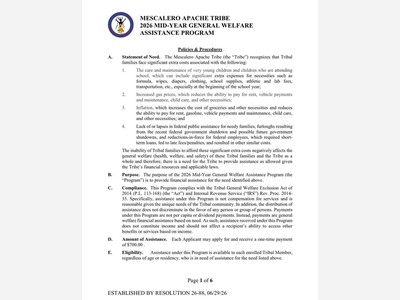

a useful example of a culture focused on helping folks, rather than taking advantage of them - we all do better when we all do better.

Sunny, with a high of 100 and low of 69 degrees. Sunny in the morning, clear overnight.

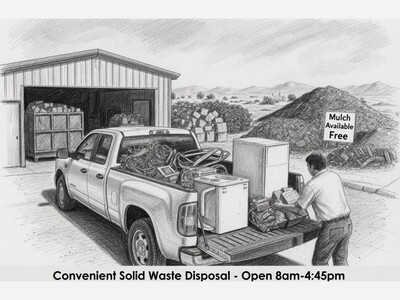
Do they still require proof of residency and you are limited to a certain amount of dumping by weight?







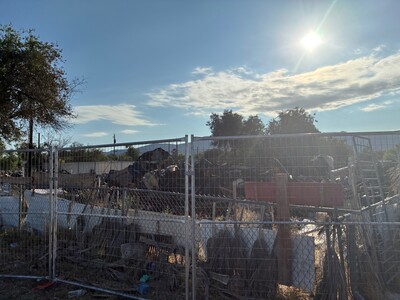
How unfortunate. Someone must have left something “cooking” in the kitchen.