61° and Patchy rain nearby

Will the Court Order Become Justification for Another Rules Violation? By Gary Person


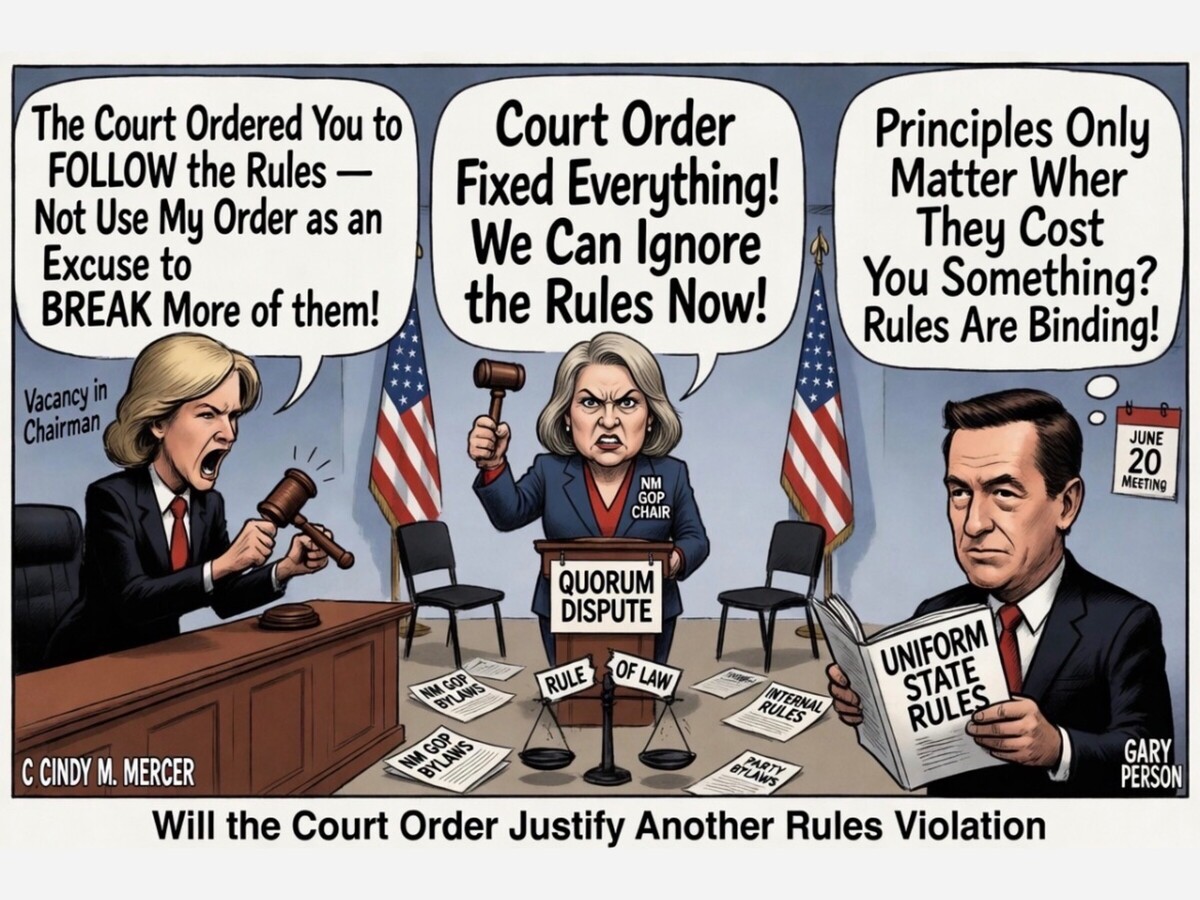
A Court-Ordered Election Does Not Eliminate the Requirement for Quorum
By Gary Person
The Republican Party of New Mexico finds itself at a crossroads.
The June 20 State Central Committee meeting has been called pursuant to Rule 2-1-4(C)(1) of the Uniform State Rules following a district court's preliminary injunction finding a substantial likelihood that the office of State Chairman became vacant under Rule 1-4-4.
The question facing Republicans is no longer simply who should serve as Chairman.
The question is whether the Rules themselves still matter.
Rule 1-4-4 is unambiguous:
"In the event the state chairman or any other state officer of the Republican State Central Committee files as a candidate for public office and there is another Republican who has filed for the same office, the state officer shall immediately vacate the party office."
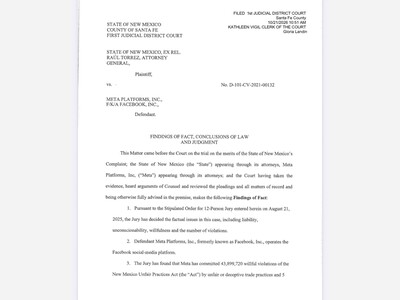
The district court concluded that the plaintiffs demonstrated a substantial likelihood of success on the merits and granted a preliminary injunction. The court further rejected arguments that enforcement of the Uniform State Rules improperly interfered with the Party's constitutional rights, holding instead that party bylaws are enforceable obligations adopted by the members themselves.
The district court did not merely issue an opinion about internal party politics. It issued a binding judicial order based upon the Uniform State Rules that Republicans themselves adopted.
In its May 27, 2026 Order Granting Plaintiffs' Motion for Preliminary Injunction, Judge Cindy M. Mercer rejected the argument that enforcing the Rules would somehow harm party leadership. Judge Mercer wrote:
"By voluntarily joining the party, Defendants agreed to be bound by its bylaws. Requiring Defendants to adhere to those bylaws cannot be considered an injury to them."
That statement cuts to the heart of the current controversy.
The Court recognized that the Uniform State Rules are not suggestions. They are the governing rules voluntarily adopted by the Republican Party of New Mexico and accepted by those who choose to serve within it.
Judge Mercer further recognized that party bylaws constitute an enforceable agreement among party members and that courts may enforce those rules when disputes arise concerning their application.
The principle recognized by Judge Mercer is not unique to New Mexico.
Courts across the country have long recognized that the governing documents of voluntary associations create enforceable obligations between the organization and its members.
In Pollock v. Crestview Country Club Association(Kansas Court of Appeals, 2009), the court recognized that disputes involving an organization's failure to follow its own rules and bylaws may be pursued as breach-of-contract claims because the relationship between the organization and its members is governed by those governing documents.
The principle is straightforward: organizations are expected to follow the rules they adopt, and members are entitled to expect those rules to be enforced fairly and consistently.
That is precisely why the Court's ruling in this case matters. The issue is not whether anyone agrees or disagrees with a particular Rule. The issue is whether the Rules that govern the Republican Party of New Mexico will be followed as written.
In other words, the issue before the Court was never whether the Rules were convenient. The issue was whether the Rules would be followed.
The Court's answer was clear.
Republicans who voluntarily join the Party voluntarily agree to be governed by its Rules.
Those Rules cannot be ignored when inconvenient.
They cannot be selectively enforced.
They cannot be applied to one member and not another.
And they cannot be suspended simply because following them produces an uncomfortable result.
As President Ronald Reagan reminded us:
"Above all, we must realize that no arsenal, or no weapon in the arsenals of the world, is so formidable as the will and moral courage of free men and women."
Today, the moral courage required is not the courage to win an argument or prevail in a political contest. It is the courage to follow the Rules even when doing so is difficult, inconvenient, or contrary to one's immediate interests.
As Charlie Kirk has observed:
"Principles are not principles unless they cost you something."
That observation applies directly to the current controversy.
It requires no courage to support the Rules when they produce the outcome we want.
The true test of principle is whether we are willing to follow the Rules when doing so is inconvenient, politically difficult, or contrary to our immediate interests.
If Republicans expect voters to trust them with the rule of law in government, Republicans must first demonstrate respect for the rule of law within their own Party.
The Court's order serves as a reminder that no officer, no committee, no coalition, and no faction stands above the Uniform State Rules.
The Rule of Law within the Party begins with the willingness to follow the Rules even when they apply to ourselves.
Yet another issue now looms.
The Official Call itself acknowledges that the meeting is being conducted because a vacancy exists and cites Rule 2-1-4(C)(1) as its authority.
The Official Call states:
"This meeting is called pursuant to Article 2, Rule 2-1-4(C)(1) of the Uniform State Rules of the Republican Party of New Mexico, which provides that, in the event of a vacancy in the office of State Chairman, a meeting of the State Central Committee shall be called within thirty (30) days for the purpose of selecting a permanent State Chairman."
The same Official Call further states:
"A Valencia County district judge has issued a preliminary injunction apparently ruling that the position of chairman is vacant."
In other words, the authority for the meeting itself depends upon recognition that a vacancy exists.
One cannot invoke Rule 2-1-4(C)(1) to call the election while simultaneously denying the vacancy that triggered the Rule.
The Rules must be applied consistently.
Not selectively.
Not conditionally.
And not based upon who wins.
As H. Beam Piper wrote in Space Viking:
"When a thing has been done wrong for years, it is often difficult to convince people that it should be done right."
That observation speaks directly to the challenge facing the Republican Party of New Mexico today.
Past practices, political convenience, personal loyalties, or institutional habits cannot override the Uniform State Rules. The fact that a Rule may have been ignored, misunderstood, or unevenly enforced in the past does not diminish its authority today.
The Court's Order did not ask whether compliance would be convenient. It did not ask whether compliance would benefit one candidate, one officer, or one faction. It asked whether the Rules would be followed.
The answer should be the same for every Republican, every officer, every county, and every faction.
If Republicans are willing to ignore the Rules when doing so produces a preferred outcome, then the Rules cease to be governing principles and become merely political tools. Once that happens, trust in the Party's leadership, elections, and governing process inevitably begins to erode.
Another issue concerns quorum.
Under the Uniform State Rules, a State Central Committee meeting must meet quorum requirements before conducting business.
Under Robert's Rules of Order, a deliberative body cannot transact substantive business without a quorum. Without a quorum, an assembly may adjourn, recess, or take limited procedural actions to obtain a quorum, but it cannot validly elect officers.
Black's Law Dictionary defines a quorum as the minimum number of members whose presence is necessary for a body to legally transact business.
The principle is straightforward.
Without a quorum, there is no authority to act.
Without authority to act, there can be no valid election.
The court ordered compliance with the Rules.
It did not suspend the Rules.
It did not waive quorum requirements.
It did not authorize the Party to disregard parliamentary procedure.
Indeed, the entire basis of the Court's ruling was that the Uniform State Rules are binding and enforceable.
That means if a quorum exists, the election should proceed and the results should be respected regardless of who wins.
If a quorum does not exist, the election cannot lawfully proceed regardless of who wins.
Furthermore, if RPNM elects a Chair without the quorum required by the Uniform State Rules, there is a substantial argument that the election would be invalid and subject to court challenge. Whether such an action would constitute a direct violation of Judge Cindy M. Mercer's May 27, 2026 Preliminary Injunction would depend upon the precise language of the injunction and the specific facts surrounding the election. However, the Court made clear that party officers and members are bound by the Uniform State Rules and that compliance with those Rules is not optional.
An election conducted without the quorum required by the Rules would raise serious questions about whether the Party is complying with both its governing documents and the spirit of the Court's Order. If the Court concluded that the Rules were being circumvented rather than followed, further judicial intervention could become necessary.
If First Vice Chairman Mike Nelson and the Republican Party of New Mexico proceed with the election and installation of a State Chairman without the quorum required by the Uniform State Rules, they would be acting contrary to the Rules that govern the Party itself.
The issue is not who wins the election.
The issue is whether the election was conducted in accordance with the Rules.
As Charlie Kirk has observed:
"Principles are not principles unless they cost you something."
The true test of leadership is not whether leaders follow the Rules when doing so benefits them. The true test is whether they follow the Rules when doing so may cost them power, convenience, or a preferred outcome.
Judge Cindy M. Mercer's May 27, 2026 Preliminary Injunction was based upon the principle that the Uniform State Rules are binding and enforceable. The Court specifically held:
"By voluntarily joining the party, Defendants agreed to be bound by its bylaws. Requiring Defendants to adhere to those bylaws cannot be considered an injury to them."
If Party leadership knowingly conducts and certifies an election without the quorum required by the Rules, critics could reasonably argue that the Party is once again attempting to circumvent the very Rules the Court ordered it to follow.
Such an election would almost certainly invite additional litigation.
Instead of focusing on defeating Democrats and winning the 2026 General Election, the Republican Party of New Mexico could once again find itself defending its internal actions in court.
The damage extends beyond legal fees and courtroom proceedings.
Every new lawsuit reinforces public perceptions of internal dysfunction.
Every court battle distracts from candidates, volunteers, fundraising, voter outreach, and the issues that matter most to New Mexico families.
Perhaps most damaging of all, repeated disputes over whether Party leaders will follow their own Rules risk undermining voter confidence in the Republican Party itself.
Republicans rightly expect government officials to follow the law.
Voters likewise expect political parties to follow their own governing Rules.
If the Party wishes to restore confidence, the solution is simple: follow the Uniform State Rules exactly as written, meet the quorum requirements, conduct a valid election, and honor the result regardless of who wins.
The Rules cannot be used to remove a chairman and then ignored when they govern the election of a successor.
The Rules cannot be cited as authority when convenient and discarded when inconvenient.
Most importantly, the court order cannot be transformed from a mandate to follow the Rules into an excuse to bypass them.
The danger facing the Republican Party of New Mexico is not simply a leadership dispute.
The greater danger is the growing perception that the Rules matter only when they produce the desired outcome.
That perception is corrosive.
It damages confidence in leadership.
It damages confidence in elections.
It damages confidence in the Party itself.
The consequences will not end with this meeting.
Volunteers will remember.
Donors will remember.
Candidates will remember.
Future officers will remember.
And they will remember whether the Republican Party chose principle or expediency.
The Court has already provided the answer Republicans should follow.
Judge Mercer reminded all parties that membership in the Republican Party carries obligations as well as privileges.
The Rules are not optional.
The Rules are not suggestions.
The Rules are binding.
And if Republicans expect voters to respect the Rule of Law in government, Republicans must first demonstrate respect for the Rule of Law within their own Party.
The June 20 meeting should not be about personalities.
It should not be about factions.
It should not be about protecting power.
It should be about one simple principle:
The Uniform State Rules and the Court's Order must be followed exactly as written, regardless of who benefits and regardless of who wins.
Anything less undermines the credibility of the Party, the authority of its Rules, and the trust of its members.
Judge Cindy M. Mercer did not order Republicans to ignore the Rules. She ordered the Rules to be enforced. If Party leaders conduct an election without the quorum required by those same Rules, they risk placing the Party back into court and reopening the very controversy the Court sought to resolve.
At a time when Republicans should be focused on winning the Governor's office, legislative seats, county offices, and local elections, continued litigation would only deepen voter concerns about whether the Republican Party of New Mexico is willing to follow its own governing Rules.
The greatest danger is not simply another lawsuit.
The greatest danger is the message it sends to Republican voters.
If Party leaders appear willing to follow the Rules only when those Rules produce a preferred outcome, voters may reasonably question whether the Party's commitment to the rule of law extends beyond campaign rhetoric.
Trust, once lost, is difficult to regain.
The Republican Party of New Mexico cannot afford to spend the 2026 General Election defending internal procedural controversies. It should be focused on defeating Democrats, electing Republicans, and presenting a vision for New Mexico's future.
That begins by following the Uniform State Rules exactly as written, honoring the Court's Order, and ensuring that any election for State Chairman is conducted lawfully, transparently, and with the quorum required by the Party's governing Rules.
— Gary Person