61° and Sunny

Faction Before Party: The Dangerous Message of the Southern & Rural Coalition


Commentary by Gary Person
Please forward to all SCC members I have limited email addresses...
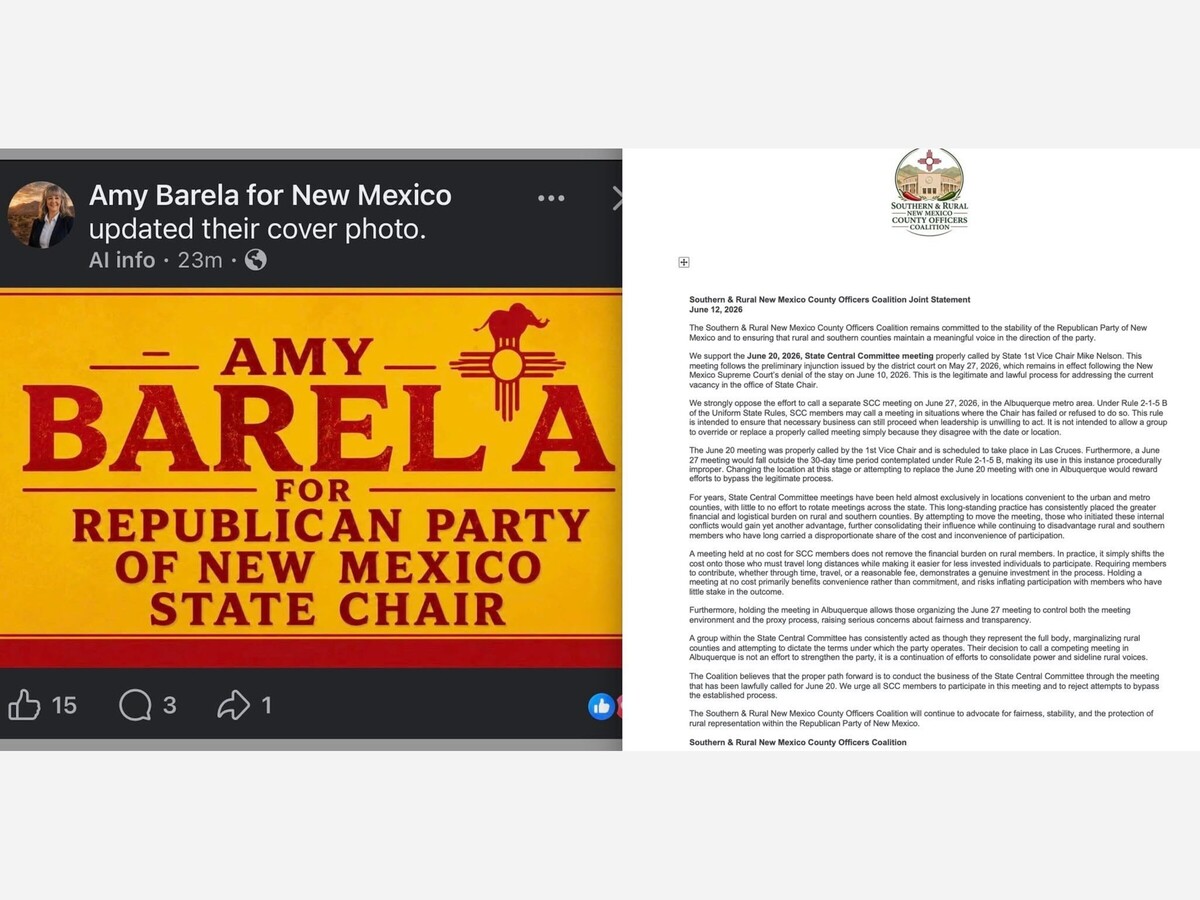
The following statement was released on June 12, 2026, by the self-described Southern & Rural New Mexico County Officers Coalition. It is reproduced in relevant part because it is the subject of this commentary.
Southern & Rural New Mexico County Officers Coalition Joint Statement
June 12, 2026
"The Southern & Rural New Mexico County Officers Coalition remains committed to the stability of the Republican Party of New Mexico and to ensuring that rural and southern counties maintain a meaningful voice in the direction of the party."
"We support the June 20, 2026, State Central Committee meeting properly called by State 1st Vice Chair Mike Nelson."
"We strongly oppose the effort to call a separate SCC meeting on June 27, 2026, in the Albuquerque metro area."
"For years, State Central Committee meetings have been held almost exclusively in locations convenient to the urban and metro counties..."
"A meeting held at no cost for SCC members does not remove the financial burden on rural members."
"A group within the State Central Committee has consistently acted as though they represent the full body, marginalizing rural counties and attempting to dictate the terms under which the party operates."
"The Southern & Rural New Mexico County Officers Coalition will continue to advocate for fairness, stability, and the protection of rural representation within the Republican Party of New Mexico."
Before addressing the substance of the statement, Republicans should note what is missing.
No signatures. No named county chairs. No named county officers. No identified authors.
The document makes serious accusations, questions the motives of fellow Republicans, and advocates a specific course of action, yet no individual is willing to publicly stand behind it.
That is not transparency.
That is not accountability.
And it is not leadership.
As Theodore Roosevelt famously observed:
"The credit belongs to the man who is actually in the arena."
If the statement truly reflects the views of county officers across southern and rural New Mexico, then those officers should have no hesitation attaching their names to it.
An unsigned political statement allows its authors to influence the debate while avoiding responsibility for their claims. If the arguments are worth making, they are worth signing.
The recently released statement from the self-described Southern & Rural New Mexico County Officers Coalition should concern every Republican in New Mexico, regardless of whether they support Amy Barela, Mike Nelson, or any candidate for State Chairman.
Not because the statement takes a position.
Not because it supports the June 20meeting in Las Cruces.
But because it openly embraces the very factionalism that the Uniform State Rules were designed to prevent.
The Republican Party of New Mexico does not have a Southern Republican Party.
It does not have a Rural Republican Party.
It does not have an Urban Republican Party.
It does not have a Metro Republican Party.
It has one Republican Party.
Yet the Coalition's statement repeatedly divides Republicans into competing geographic camps, portraying the current dispute as a struggle between southern and rural counties on one side and urban and metro counties on the other.
That should alarm anyone who has actually read the Uniform State Rules.
Rule 2-1-2(B) grants the State Central Committee the authority:
"To settle factional differences and to prevent damage to party welfare."
Notice what the Rule does not say.
It does not authorize party leaders to create factions.
It does not encourage Republicans to organize themselves into competing regional blocs.
It does not promote a system where Republicans identify first as southern Republicans, rural Republicans, metro Republicans, or urban Republicans.
Instead, the Rule recognizes that factional differences are a threat to party welfare and places responsibility upon the State Central Committee to resolve those differences before they damage the Party.
Yet the Coalition's statement does precisely the opposite.
By defining itself as a geographic faction and portraying the current dispute as a struggle between competing regions of New Mexico, the Coalition reinforces the very divisions the Rules instruct party leadership to overcome.
It repeatedly accuses fellow Republicans of attempting to "consolidate power."
It claims others seek to "sideline rural voices."
It argues that one group is attempting to dictate how the Party operates.
Whether those accusations are true is almost beside the point.
The result is the same: deeper division, greater distrust, and further damage to the Republican Party of New Mexico.
The irony is difficult to ignore.
A statement claiming to promote stability does so by reinforcing regional grievances.
A statement claiming to defend fairness does so by openly advocating for a process that benefits one region over another.
A statement claiming to oppose factionalism does so under the banner of a faction.
The Coalition also mischaracterizes the Uniform State Rules.
The statement claims Rule 2-1-5(B) exists only when leadership fails or refuses to call a meeting. That is not what the Rule says.
Rule 2-1-5(B) provides:
"Any twenty-five (25) or more members of the State Central Committee, acting in unison, shall have the power to call meetings of the State Central Committee along with a written agenda of specific issues by giving proper notice."
The Rule contains no requirement that a chair refuse to act.
The Rule contains no requirement that a vacancy exist.
The Rule contains no requirement that SCC members first obtain permission from party leadership.
The Rule is a direct grant of authority from the SCC itself to the SCC membership.
Attempting to rewrite the Rule to fit a political narrative does not change what the Rule actually says.
The statement further argues that a June 27meeting would violate a thirty-day requirement under Rule 2-1-5(B).
That claim is simply incorrect.
Rule 2-1-5(B) contains no thirty-day limitation whatsoever.
The thirty-day requirement appears in Rule 2-1-4(C)(1), the vacancy rule governing the First Vice Chair's responsibility to call a meeting following a vacancy in the chairmanship.
These are separate rules serving separate purposes.
Conflating them does not strengthen the argument; it weakens it.
Even more troubling is the Coalition's argument that requiring members to bear travel burdens or fees somehow demonstrates commitment.
That argument stands in direct tension with one of the most important principles in the Uniform State Rules.
Rule 1-2-1(B) states:
"It is the intent and purpose of these rules to encourage and allow the broadest possible participation of all Republican voters in Republican Party activities at all levels and to assure that the Republican Party is open and accessible."
Broad participation.
Open and accessible.
Those are not accidental words.
They are the stated purpose of the Rules.
The Rules do not say participation should be limited by geography.
The Rules do not say participation should be restricted to those who can afford travel expenses.
The Rules do not say participation should depend upon who is willing to spend the most money to attend a meeting.
The Rules say the Party should encourage the broadest possible participation.
Perhaps the greatest irony of all is that the Coalition claims to oppose consolidation of power while simultaneously advocating a process that many Republicans believe advantages one geographic region over another.
If Albuquerque meetings that favored metro counties were wrong, then meetings that favor southern counties are equally wrong.
Fairness cannot depend on who benefits.
The current controversy began because Rule 1-4-4 states:
"In the event the state chairman or any other state officer of the Republican State Central Committee files as a candidate for public office and there is another Republican who has filed for the same office, the state officer shall immediately vacate the party office."
The Rule does not say "may."
It does not say "if convenient."
It does not say "after consultation with attorneys."
It says "shall."
A district court found a substantial likelihood that the Rule required the office to be vacated.
The New Mexico Supreme Court declined to stay that order.
Yet even now, Republicans are being asked to view the controversy through the lens of geography rather than governance, faction rather than fairness, and political advantage rather than principle.
The Party should now be focused on restoring confidence in the Rules, not creating new factions and new divisions.
The damage from this controversy will not end with one SCC meeting.
It will be felt for years.
Volunteers will remember it.
Candidates will remember it.
Donors will remember it.
Future officers will remember it.
And they will remember whether the Republican Party chose principle over faction.
The consequences are likely to be felt for at least the next three election cycles.
The first impact will be on volunteers and activists. Trust, once lost, is difficult to regain.
The second impact will be on candidate recruitment. Strong Republican candidates want to spend their time defeating Democrats, not navigating internal party disputes.
The third impact will be on fundraising. Donors seek stability, accountability, and confidence in leadership. Continued litigation, controversy, and factional conflict discourage investment in the Party's future.
Most importantly, this controversy risks creating a precedent that future leaders may follow whenever the Rules become inconvenient.
Rule 2-1-2(B) charges the SCC with preventing damage to party welfare.
The surest way to damage party welfare is to convince Republicans that the Rules apply differently depending on who holds power.
The future of the Republican Party of New Mexico will not be determined by whether one faction wins.
It will be determined by whether Republicans remain committed to one Party, one set of Rules, and one standard of accountability for everyone.
Because once Republicans begin identifying themselves primarily by faction rather than principle, the damage extends far beyond a single chairman's race.
It reaches into future elections, future candidates, future volunteers, future donors, and the public credibility of the Party itself.
The Republican Party of New Mexico has a choice.
It can continue down the path of competing factions, competing narratives, and competing standards.
Or it can recommit itself to the simple idea that no person, no officer, no coalition, and no faction is more important than the Rules.
For the sake of the Party's future, one can only hope it chooses wisely.
— Gary Person