
 45° and Clear
Image

Alamogordo City Manager Performance Review Scheduled: Seventy Days In



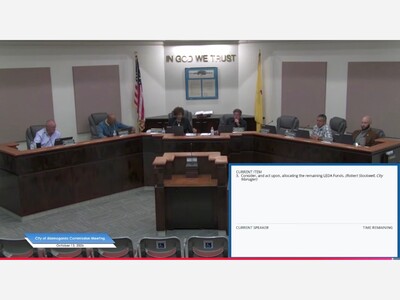
Alamogordo N.M. - On September 8, 2026, the Alamogordo City Commission will hold its regular meeting. One item deserves particular attention:
By September 8, City Manager Robert Stockwell will be in office for approximately 70 calendar days.
Seventy days is certainly not enough time to fully judge an administration. But it is enough time to begin evaluating direction: What has moved forward? What has stalled? How well is the public being informed? How are employees being led?
A performance review should not be viewed as an attack on a city manager. It is one of the Commission's most important responsibilities.
Bonito Lake: The First Major Test
One of Stockwell’s first significant policy recommendations involved Bonito Lake. On August 25, he recommended ending recreational access and proposed fencing that could have cost up to $1 million. The proposal generated substantial opposition from Alamogordo and surrounding communities. Following significant public engagement, Stockwell changed direction and announced that he would instead recommend maintaining fishing access while limiting fencing primarily to the dam area.
Changing direction after hearing from the public is not the problem. The problem is that r reporting by Alamogordo Town News identified a $250,000 legislative appropriation tied to reopening and day-use improvements, the existing Open Gate arrangement, negotiations for a multimillion-dollar project, and improvement work already underway. Those facts should have been part of the original recommendation and public discussion and were admitted to and confirmed by the city during the Voices of Alamogordo Community Forum not during the policy briefing to the commission and the public. This was a major error in informing the commission and the public about the true status of the lake.
The lesson from Bonito is simple: the public should not have to challenge a recommendation before receiving the full picture.
Access and Communication
Stockwell also reopened portions of City Hall during the lunch hour. On its face, expanding public access sounds positive.
However, this outlet has received complaints that the utility billing/cashiering operation, the area many citizens actually use, remains unavailable until 1 p.m. If that is accurate, the change may not have solved the primary access problem for residents who need to conduct business during lunch.
That is the difference between changing hours and actually improving service. The performance review should ask whether the change produced any real benefit or whether it was simply smoke and mirrors, a visible change pushed by Commissioners Rardin and Hernandez, who had repeatedly called on the record for City Hall to remain open during lunch, while the primary public-facing service remained closed.
Communication is another concern.
During 2025 and the first half of 2026, residents regularly received project updates, department information and Commission presentations explaining what was happening across the City. That flow of information has slowed considerably.
At least two employees have told this outlet that managers should no longer speak during Commission meetings and that information is expected to come through department directors. But managers are often the employees working directly with projects and citizens and may have the most detailed operational knowledge.
The issue is not simply who speaks. The issue is whether information is reaching the Commission and the public, or whether there is a deliberate effort to stifle communication and control the flow of information.
What Happened to the Project Pipeline?
Stockwell did not inherit an empty project list.
Earlier this year, 2nd Life Media Alamogordo Town News reported extensively on major water, sewer, road, public safety and recreation projects to be awarded to bid in 2026. On May 2, Dr. Hernandez reported that the City had completed 12 major projects, had approximately 20 more in progress and another eight ready to move forward. Project updates were again publicly presented at the May 26 Commission meeting.
When this outlet asked Hernandez about that project pipeline as she prepared to leave, she said, “Many were wrapping up and we had some major ones on deck”. The City also had significant financing identified, including the approximately $12 million natatorium financing and $28 million approved water and sewer funding.
When asked whether she intended to put additional projects out before leaving, Dr. Hernandez said:
“No. My focus is on wrapping up what I can and leaving the next round of projects to the incoming administration. There are several projects that are ready to go, with funding already identified, and simply need to be put out. My priority during my time as City Manager was to move forward projects that had been sidelined or delayed through the turnover in leadership. Every city manager brings a different perspective and may prioritize projects differently. From a professional and transition standpoint, I did not think it was appropriate to launch any major new initiatives without City Manager Stockwell’s input.”
The only public update we have seen has come from the Mayor’s Office. While that update said several major projects were expected to move forward, we have yet to see confirmation that they have actually been advertised or awarded. This outlet continues to monitor City bid postings and procurement activity, and the public record does not yet show the level of movement suggested in that update.
Many projects now appear delayed, yet there has been little public explanation, and seemingly little communication to the Commission, about why or when they will move forward.
That silence is creating another concern.
Some contractors have told this outlet they were not given an opportunity to bid on certain work. There is also concern that work could be directed to a contractor(s) with ties to Mayor Pro Tem Rardin. That allegation is not yet proven, which is exactly why the City should put the procurement record on the table:
Who had an opportunity to bid? Who submitted proposals?
How was the contractor selected?
And did any commissioner have involvement in the process?
If the process is clean, the records should show it. IPRA requests are pending on how awards were recently given to work that would normally go to the on call contractor.
The Natatorium Deserves Clarity
The Natatorium raises another obvious question.
Sources have raised concerns that the City is considering spending approximately $1 million on outside project-management services, potentially using money otherwise available to construct the pool.
Why?
The City already has two project managers on staff. For more than a year, the Senior Project Manager successfully completed and kept numerous major capital projects moving while serving as the City’s primary project manager. A second project manager was hired earlier this year.
If that internal capacity already exists, why spend approximately $1 million on additional outside management instead of putting that money directly into the Natatorium?
That matters because the pool had already been scaled back to remain within approximately $12 million in available financing. If another $1 million is removed, what else gets cut? Features? Amenities? Improvements?
This outlet contacted former City Manager Hernandez regarding the issue. Her response was:
“At the time I left, the idea had been discussed, but nothing was finalized, and the initial cost estimate was extremely high. If another funding source could have been used instead of taking money from the pool, I would have supported it. But even with the $12 million loan, the pool design had already been scaled back, and I was not in favor of reducing it further. Any current updates should come from the City Manager Office or the Community Development Department that oversees this project”
Until the City explains whether an additional project-management contract is being pursued, what it will cost, why outside management is necessary when two project managers are already employed, and what funding source will pay for it, the question remains:
Why spend money managing the pool that could instead be spent building the pool?
Experience Comes With Expectations
Some will argue that Stockwell has only been City Manager for a little more than two months.
That argument only goes so far.
Mayor Pro Tem Rardin repeatedly emphasized Stockwell’s decades of city-management experience, his long association with ICMA and the fact that he previously served as Alamogordo City Manager. He was not presented as someone who needed months to learn municipal government or Alamogordo. His experience was part of the justification for hiring him.
So was his compensation.
Stockwell's base salary is $180,000. When the $6,000 vehicle allowance, retirement contributions, insurance, retiree-health contribution, ICMA membership and other employer-paid benefits are included, his estimated recurring compensation package is approximately $236,700 to $242,200 annually.
With that level of experience and compensation, the public should expect leadership, communication, project movement, organizational stability and informed recommendations.
Employee Leadership Matters Too
Employees inside City Hall have described increased tension and uncertainty. A transition can create discomfort, but transition cannot become a blanket excuse for an unhealthy working environment.
Former Mayor Payne summarized her concern this way:
“They are taking us back to a time when employees feared the commissioners. Being a commissioner meant walking into city hall and ordering staff and the city manger just sat in their office and did nothing to protect their employees. Following ICMA best practices, That’s not the way it’s supposed to work”
Payne’s comments are especially relevant because this appears to be exactly the environment Mayor Pro Tem Rardin has wanted to restore, one where commissioners can exert direct influence inside City Hall, employees are reluctant to challenge them, and the City Manager does little to stop it.
That is precisely why the City Manager’s independence matters.
Some residents were concerned from the beginning that Stockwell’s appointment would make him more responsive to a four-member Commission majority than to the organization and broader community. Seventy days in, the pattern increasingly gives those concerns weight.
The question is whether Stockwell is acting as the professional barrier between politics and administration, or enabling the very culture Payne described.
Is he protecting the professional role of staff?
Is he providing complete information to all seven commissioners?
Is he maintaining meaningful communication with the public?
And is he willing to tell commissioners no when their involvement crosses from policy into administration?
Those are City Manager questions.
Accountability Is Part of the Job
The September 8 performance review should not be about personalities or political sides.
It should be about measurable leadership.
Are funded projects moving?
Is the Commission receiving complete information before major recommendations are made?
Are citizens receiving regular updates?
Are changes at City Hall substantive or merely façade improvements?
Are employees being supported and allowed to provide their professional expertise?
And most importantly, is the City Manager providing the independent professional management Alamogordo is paying for?
The Commission hired the City Manager. Evaluating his performance is part of governing.
After approximately 70 days, there is enough of a record to start asking those questions.
The Final Question Is Transparency
The Commission is recessing into executive session, not adjourning the meeting. It will return to open session afterward.
Closed-session confidentiality does not require silence once they return.
Citizens can reasonably expect some indication of the outcome: Were expectations established? Were concerns addressed? What should the public expect going forward?
After 70 days of questions about communication, project direction and transparency, what happens when the Commission returns to open session may tell citizens just as much as what happens behind closed doors.
Will the Commission and City Manager provide a meaningful glimpse of where this administration is headed?
Or will they reconvene, say little, and once again leave the public with more questions than answers?



Received that crime flyer in the mail today. Wow! Mudslinging V2.0 by the blockheads as usual.
Lacks proper education. Illegitimate kids, toxic relationships, social work survivor, homeless lady, owning a non-profit advocacy? Uh, you're supposed to get better, not run for office on that stuff. We won't vote for her because she's not qualified. Word of advice: SALAD, honey.

Sunny, with a high of 61 and low of 44 degrees. Sunny in the morning, clear for the afternoon and evening,



For those of the civilian public to understand. Every single Airman, marine, sailor and soldier whether Active duty or reserve or national guard has had explicit training on the UCMJ and illegal orders. This includes every “veteran for peace” It is political plain and simple.


Couple of people around Santa Fe have told me her highness has been sucking up hard to Ant to get on to a staff job when his pending doom curtain closes here. Queens never learn to really be honest. It's just in their realm of mental health. They live in denial and have pent up retentive r.e.c.t.u.m.s.
His money would have been better spent listing all of his accomplishments while in office. Oh, wait……
Voted twice against the low-income utility rate bill (HB 91) and sponsored the failed 2026 tax on renewable generation (HB 113) which the state confirmed would have further raised PNM rates. We know who has you in their pocket Block. Stop the **** lies!

Million-nine for the bakery, million for a theatre scam. These uneducated skells pass out money to sheis for what? They're not even good ideas. 3 mil and they don't know? Why doesn't we hire out side auditor like the FBI?
All that tax money. Is it true that Brien Caesar bought a four hundred k condo in wyoming last year? Heard, it's near Jackson. Someone put that stuff through. No wonder they change managers so often. Once a deals's done you don't have to stick around in this burg anymore.



Is there any chance that the Forest Service will allow Sunspot to remain open, after the demolition is completed?