
Image
Inside the Collapse of Timberon’s Water District — and the Cleanest Way Out - AlamogordoTownNews.org



A review of court records, regulatory filings, board minutes, and reporting from Otero County shows a small mountain water utility that has now failed the same way twice — and a state regulator once again weighing whether to take it away from its elected board.
TIMBERON, N.M. — Twice in less than twenty years, New Mexico regulators have looked at the Timberon Water and Sanitation District and asked the same question: should a court simply take it over? The first time, around 2008, it happened — TWSD’s own records show a court-ordered receivership and court-set interim rates.
The second time may be upcoming!
In November 2025, Public Regulation Commission member Patrick O’Connell told fellow commissioners the district “is not functioning” and raised receivership again, asking how many more failures the state needed to see before concluding a fine wasn’t enough.
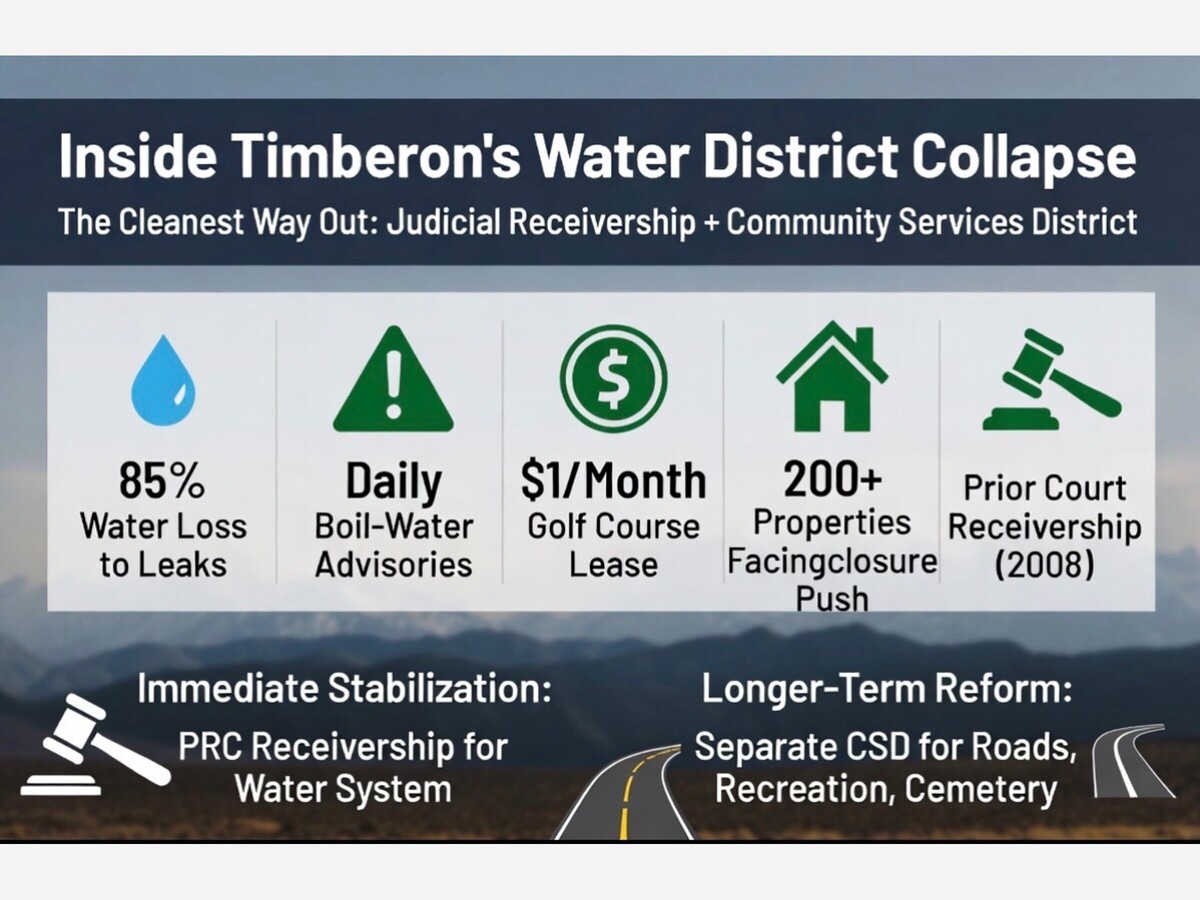
Between those two moments sits nearly two decades of litigation, tax disputes, open-meetings violations, and — in the past several weeks alone — three boil-water advisories, a hidden drinking-water violation, a golf course leased to a private operator for a dollar a month, a closed swimming pool, and a board move toward foreclosing on more than 200 delinquent ratepayers while the system that serves them keeps failing. Understanding how Timberon got here — and what would actually fix it — requires walking through the whole record.
How a Tax Ruling Became a Governance Problem
TWSD was established in 1992 to provide water, sanitation, and — according to its own website — road maintenance, a cemetery, a golf course, a swimming pool, and other recreational facilities to the roughly 9,000-acre community. That broad mandate ran on property tax revenue until 2006, when the Twelfth Judicial District Court ruled in Gambel v. TWSD that the Community Service District Act’s 10-mill property tax cap (NMSA 1978 §4-54-4) applied to water and sanitation districts. The ruling was certified as a final, appealable judgment. By the district’s own account to property owners, it cut TWSD’s tax revenue from roughly $364,000 to $134,000 a year — a loss of about $230,000 annually that had funded everything outside the water system itself.
Rather than shed those non-water services, the board voted in June 2012 to create a “Facilities and Services” (F&S) charge, billed to every property owner, explicitly to replace the lost tax revenue. The district’s own letter to residents that month said as much and itemized what the money would fund: road grading across 184 miles, the golf course, the pool, the cemetery, snow removal, trash hauling. That decision — replacing a capped tax with a new fee that funded the same non-water obligations — is the root of most of what has followed.
A District That’s Been Here Before
TWSD’s own public records include a “Final Receivership Order” and “Court Ordered Interim Rates” dating to around 2008 — meaning this is not the first time a court has had to step in and run the district’s water rates and operations from the bench. That history matters directly to the question of what happens next: a legal mechanism for placing TWSD under judicial receivership already exists, has already been used on this exact entity, and does not depend on resolving any of the newer legal questions raised by the community’s current governance-reform proposal.
Compliance Issues and Litigation, Piling Up
Since that 2012 fee was created, TWSD has accumulated an unusually dense litigation and regulatory record for a district serving roughly 600 households:
• PRC Docket 25-00011-UT (Mark Harding and Barbara Shockley) began over individual billing errors and expanded into a district-wide audit order. TWSD was ordered in December 2025 to audit its billing back to mid-2024 and prove it had issued required customer credits — a deadline extended once, to May 20, 2026. TWSD says it complied; both the complainants and the Commission itself said in late May that the proof submitted wasn’t sufficient. The docket remains open.
• PRC Docket 26-0000053 (Michael Gonzalez) argues the F&S fee is functioning as a disguised utility charge that should have required PRC approval — and, in a July 2026 filing, ties the fee’s 2012 origin directly to the 2006 tax judgment as evidence of a deliberate workaround. The PRC has not ruled on jurisdiction.
• At least eight Open Meetings Act complaints have been filed with the state Department of Justice since 2023. In November 2025, the DOJ found the board had “repeatedly violated” the Act, including improperly closing meetings under invalid claims of attorney-client privilege and disciplining an employee outside any public meeting. The agency’s deadlines — training by January 2026, cured violations reported back by May 2026 — have passed; no documentation confirming that reporting was found in the available record.
• An August 2024 letter from the district’s own law firm, Rodey, Dickason, Sloan, Akin & Robb, demanded $126,645.62 in unpaid legal invoices and threatened to withdraw from every pending case — including active litigation — if unpaid, while noting the firm’s own work had helped TWSD avoid “becoming insolvent or going into receivership” through a 2024 rate increase.
• A separate civil case, Massey v. Hanson and TWSD (Otero County District Court No. D-1215-CV-202500808), shows the district is already engaged in unrelated civil litigation in the same court that would have jurisdiction over any receivership petition.
None of these cases has produced a final resolution of TWSD’s underlying problems.
Each has instead documented another piece of the same pattern: financial strain, procedural noncompliance, and a board managing crises one complaint at a time.
The Present Crisis: Boiling Water, Broken Pipes, and a Hidden Violation
The district’s infrastructure problems are not new — a 2023 investigation found the system was losing approximately 85 percent of its treated water to leaks, much of it through thin-walled PVC pipe never rated for pressurized drinking water, with roughly half the community’s fire hydrants unusable. But the past several weeks have compounded that baseline failure. TWSD issued precautionary boil-water advisories on June 8, June 16, and July 8, 2026 — three in five weeks — each following a tank-pressure collapse. Board Chairman Otis Price has said the roughly 50-year-old system, built with substandard materials, is now failing faster than crews can repair it, citing close to 50 pipe breaks in a single month.
Separately, the New Mexico Environment Department issued a Notice of Violation on June 9, 2026, finding that TWSD failed to notify its own customers of an earlier drinking-water violation issued back in March — and failed to tell the state it had done so, as required within 10 days of any public notice going out.
NMED’s letter states the requirement was simply not met, and warns the district will now appear on the department’s public Enforcement Watch list, with NMED planning to notify local media directly. It is not the district’s only appearance there: NMED’s Resource Protection bureau has separately cited TWSD for operating an unregistered solid waste site since 1996.
A Golf Course for a Dollar a Month, a Pool That Never Opened
Against that backdrop, board minutes show TWSD approved a 10-year lease of its district-owned golf course and lounge building to a private operator, Discover Timberon Inc., for $1 a month — publicly noticed and voted 3–1 at an April 2025 meeting, with the district’s treasurer casting the dissenting vote over insurance concerns. Under the lease, the operator keeps 100 percent of profits while TWSD receives $12 a year and no revenue share, and no appraisal or market-rate comparison appears in the board’s own record of that vote — a gap that matters because New Mexico’s Anti-Donation Clause (N.M. Const. art. IX, §14) bars public bodies from giving away things of value to private parties without receiving fair consideration in return.
The same board separately voted, at that same meeting, to competitively bid a waste-management contract — showing it knew how to run a bid process when it used one.
Weeks later, TWSD announced the community pool — which lost roughly $26,500 against about $3,500 in revenue the prior summer — would not open for the season, citing a lack of funds and ongoing water concerns.
Collecting From Ratepayers While the Taps Run Dry
The district’s most recent public board agenda, posted July 11, 2026, shows the board moving toward collections at the same time service is failing.
Item 5 approved 18 liens on standby lots totaling $4,430.10; item 6 proposed a “test” foreclosure against delinquent standby-fee accounts.
More than 200 properties are reportedly now eligible for foreclosure over unpaid fees, with the board having directed its attorney to review foreclosure options. Though historic documents show a procedure was previously in place thus why the need for a “test?
The same agenda proposed creating a leak-detection crew and expanding remote monitoring of the system — an implicit acknowledgment that neither exists yet in adequate form.
A prior board meeting’s own five-year capital plan ranked “Water System Replacement” as the district’s top infrastructure priority, alongside well rehabilitation and a new filtration unit — meaning the district’s own planning documents agree the core system needs rebuilding, even as ratepayers face collection action over bills owed to a utility currently under a boil-water advisory.
What Would Actually Fix This
Timberon’s former leadership has proposed a two-district governance model — leaving TWSD to focus solely on water while a new Community Service District, formed by Otero County, would take over roads, recreation, and the cemetery
That plan could potentially address the “mission creep” side of TWSD’s problems, but two things limit how quickly it could work.
First, it does not touch TWSD’s water infrastructure directly — the boil advisories, the pipe failures, and the NMED violations would remain TWSD’s to fix regardless of what happens to the golf course or the roads.
Second, the specific state statute the plan cites for county authority to form the new district is a law governing narrow, single-project assessment districts, not standing multi-service governments — meaning the legal path for that half of the plan is not yet settled and would likely need further legal review, and possibly new state legislation, before a petition could be filed.
By comparison, a more direct and better-precedented path may already exists for the water system itself: judicial receivership, initiated by the PRC.
This is not a novel or untested idea for New Mexico’s small troubled water utilities — the PRC has pursued or discussed exactly this remedy in multiple recent cases, including a private utility in San Juan County and the Camino Real Regional Utility Authority in Sunland Park, both within the past year.
It is also not novel for TWSD specifically: the district’s own records show it was placed under a court-ordered receivership once before, around 2008, with a court setting interim rates during that period. A receivership would not require new legislation, would not depend on resolving the CSD’s open legal questions, and could be pursued through the existing PRC docket (25-00011-UT) already open against the district — the same docket a commissioner has already publicly floated receivership in.
Receivership would not by itself solve TWSD’s money problem — the district’s own former board chair has said the system needs $45 million to $50 million in infrastructure investment, and a receiver doesn’t bring new funding, only professional management and legal authority to act. But it would address the governance failures — the OMA violations, the undisclosed NMED violation, the golf course lease, the foreclosure push — by removing decision-making from an elected board that has, on the documented record, struggled to comply with its existing legal obligations. A parallel and non-exclusive option under New Mexico law is board removal through the courts under NMSA 1978 §73-21-12, with unfilled vacancies reverting to the district court under §73-21-13 — a slower, more democratic mechanism that residents can pursue directly without waiting on the PRC.
Realistically, the fastest and cleanest resolution likely combines pieces of both: PRC-driven receivership or court-supervised management to stabilize water operations immediately, alongside continued board-removal and ethics/records enforcement to address the accountability failures, with the community’s own CSD proposal — or an alternative legislative fix — addressing the non-water services on a longer timeline once the underlying legal question is resolved.
Why This Matters to Otero County
Timberon is unincorporated, which means Otero County has no direct governing authority over TWSD today — but the county is the body any new district would need to petition, and county residents and emergency responders bear real, immediate exposure to what happens in Timberon regardless of which government eventually runs it.
A water system that has lost the ability to reliably deliver water or verify its own test results is also a system that cannot reliably support fire suppression — a public-safety concern that doesn’t stop at Timberon’s boundary.
A district that cannot demonstrate the “Technical, Managerial, and Financial” capacity state and federal regulators require also cannot draw down the infrastructure funding that would otherwise fix the problem, leaving state and county resources as the more likely fallback the longer the current governance structure persists.
There is also a public trust question that outlasts any single lawsuits.
Twenty years of tax disputes, a fee created explicitly to work around a court order, repeated open-meetings violations, an undisclosed drinking-water violation, and a public asset leased away for a dollar a month are not, individually, unusual problems for a small rural utility to face. Together, and especially given that this district has already been through receivership once before, they describe an institution that has not demonstrated it can self-correct without outside intervention — which is precisely the finding that state regulators are now weighing whether to act on again.
This Alamogordo Town News article is part of series and is based on a review of court orders, PRC filings, DOJ correspondence, board meeting records, IPRA responses, and reporting on the district’s current crisis, along with independent verification of the New Mexico statutes discussed. It is a factual summary, not legal advice. Where a fact could not be independently confirmed from the records reviewed, that limitation is noted directly in the text rather than presumed.



Sunny, with a high of 81 and low of 61 degrees. Sunny in the morning, patchy rain nearby in the afternoon and evening, clear overnight.



Having the Sierra Club endorse you is like drinking the runoff from a lithium mine they spent a decade blocking—then calling the metallic taste “sustainability.” This phoney has a really bad dye job.
Just because you do not like someone does not make them phony.
kinda like not liking the blue kool aid so you hate all the kool aid. Besides doesn’t the editor have a vested interest in her campaign?





as per occam's razor, the simplest explanation for stonewalling a request this basic and straight forward, is that transparency will cast a bad light on lincoln county, and/or the entity they pay to run their jail.
The Albuquerque Journal (9/20/26, page C3) has a column written by Jacob Candelaria that is titled "A blacklist for people who ask too many questions". Basically, in 2025, our NM Legislators were debating House Bill 139 would have let any public body petition to have a person designated as "vexatious", and person's



like 99% of his fellow republicans, block is a servant to the oil & gas industry - a principal constituent of their party.