61° and Sunny

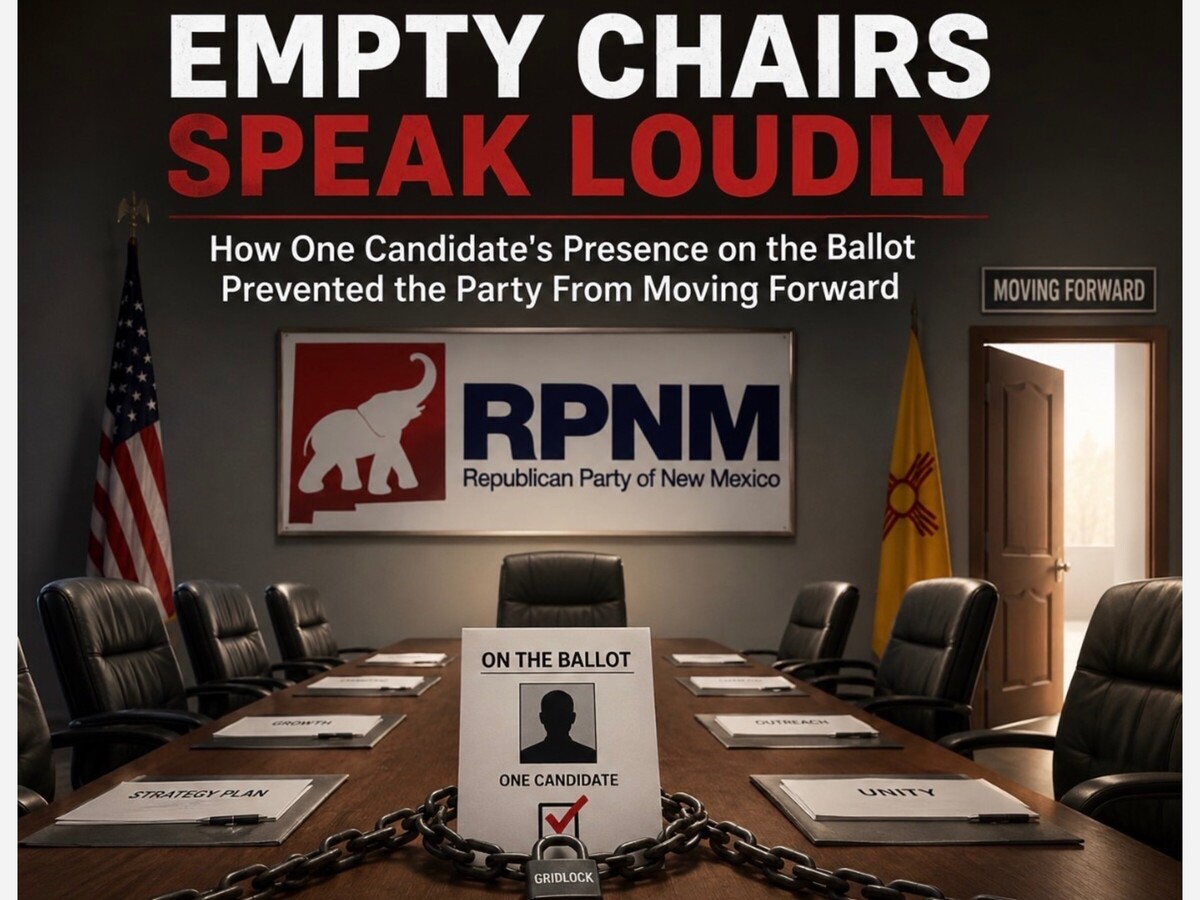
Empty Chairs Speak Loudly An op-ed By Gary Person


How One Candidate's Presence on the Ballot Prevented the Party From Moving Forward
An op-ed By Gary Person
The June 20 meeting of the Republican Party of New Mexico's State Central Committee was intended to bring closure to months of controversy. Instead, it exposed just how deeply that controversy has affected the governing body of the Party.
The purpose of the meeting was straightforward. The SCC was called to elect a State Chairman and provide the Party with a path forward. Yet when Republicans gathered in Las Cruces, the meeting failed to achieve quorum. According to reports from the meeting, only 79 members attended in person and 84 participated by proxy. Under the Uniform State Rules, a State Central Committee meeting requires two-thirds of the membership representing two-thirds of New Mexico counties in order to conduct business. Without quorum, no chairman could be elected and the meeting adjourned without accomplishing the very purpose for which it had been called.
Many explanations have been offered for the failure. Some have pointed to the location. Others have blamed the quorum requirement adopted in Hobbs. Still others have pointed to the ongoing litigation and uncertainty surrounding the chairmanship dispute. While each of those factors may have played some role, they do not fully explain why one of the most important meetings in recent Party history generated such limited participation.
The more likely explanation is that the Republican Party of New Mexico was not suffering from a lack of interest in electing a chairman. Rather, it was suffering from a lack of confidence in the circumstances surrounding the election itself. By June 20, the election had become less about selecting a chairman and more about resolving the controversy surrounding Amy Barela's continued role within the Party.
Virtually every major dispute that has consumed the Republican Party over the past several months has centered on that controversy. The litigation centered on Amy Barela. The debate regarding USR 1-4-4 centered on Amy Barela. The competing interpretations of Party rules, the public statements, the open letters, and the competing SCC meeting calls all traced back to the same unresolved question. USR 1-4-4 states that when a state officer files for public office and another Republican has filed for the same office, that officer shall immediately vacate the party office. Whether one agrees with that interpretation or not, there can be little dispute that the controversy became the dominant issue before the SCC.
That reality helps explain why the June 20 meeting failed.
Had Amy Barela not been on the ballot, it is highly likely that quorum would have been achieved and a new chairman would have been elected. The SCC was not being asked to choose among candidates in a routine election. Members were being asked to participate in a process overshadowed by months of litigation, controversy, competing narratives, and questions regarding the chairmanship itself. By the time members arrived in Las Cruces—or chose not to arrive—the election had become a referendum on the crisis surrounding the Party rather than a simple leadership contest.
No formal vote was ever taken on Amy Barela's leadership. Yet the inability to gather enough members to conduct business may have been the clearest indication available of how much confidence had been lost. The SCC had one job on June 20: elect a chairman. Instead, the governing body effectively refused to provide the participation necessary to move forward.
The June 20 result also raises serious questions about the claims made by the Southern & Rural New Mexico County Officers Coalition. Prior to the meeting, the Coalition strongly supported the Las Cruces gathering and strongly opposed efforts to hold an SCC meeting in the Albuquerque area. The statement portrayed the conflict largely as a struggle between rural Republicans and urban Republicans and suggested that certain factions were attempting to impose their will on the rest of the Party.
The events that followed suggest a very different reality.
If the Coalition truly reflected the prevailing sentiment of the State Central Committee, quorum would have been achieved and the election completed. If the Coalition accurately understood the mood of the governing body, June 20 would have produced a chairman. Instead, the meeting collapsed for lack of participation.
The conclusion is difficult to avoid. The Southern & Rural New Mexico County Officers Coalition appears to have been badly out of touch with the broader SCC membership. The failure to achieve quorum demonstrated that dissatisfaction extended well beyond any perceived Albuquerque faction and well beyond any regional divide. The governing body did not rally behind the status quo. It withheld the support necessary to continue it.
In fact, some of the strongest criticism of the current situation came from outside Albuquerque.
The Republican Party of Sierra County publicly called for Amy Barela's resignation, citing confusion, negativity, and growing distrust within the Party. The letter was signed not by a single individual but by the county's leadership team, including its chairman, vice chairmen, secretary, treasurer, members-at-large, and former congressional district leadership. Their conclusion was straightforward: the controversy had become a distraction from the Party's mission of electing Republicans.
Former First Vice Chairman Rick Lopez reached a similar conclusion. In his open letter, Lopez praised Amy Barela's years of service but argued that her refusal to acknowledge the consequences of USR 1-4-4 was placing both the Party and Republican candidates at risk. He urged her to "Ride for the Band" and step aside for the good of the organization.
Neither Sierra County nor Rick Lopez can reasonably be dismissed as representatives of an Albuquerque political faction. They represent different regions, different experiences, and different generations of Republican leadership. Yet they arrived at remarkably similar conclusions.
What emerged from June 20 was not evidence of a divide between rural Republicans and urban Republicans. Rather, it was evidence of a growing divide between Party leadership and the governing body itself.
Perhaps the greatest irony came immediately afterward. After months of arguments that Albuquerque-area meetings somehow disadvantaged rural Republicans, the replacement SCC meeting was scheduled for Isleta Resort in Albuquerque. That decision was an implicit acknowledgment that geography was never the central issue. The real issue was confidence, and confidence is something no change of venue can restore.
The Republican Party of New Mexico faces important elections in 2026. Republicans should be discussing how to defeat Democrats, expand voter registration, recruit candidates, support nominees, and build winning campaigns. Instead, the Party remains trapped in a leadership dispute that has overshadowed nearly every other priority.
At some point, every political organization must decide whether preserving a controversy is more important than resolving it.
The June 20 meeting may have provided that answer.
It was not delivered through speeches.
It was not delivered through resolutions.
It was not delivered through floor debates.
It was delivered through empty chairs.
And sometimes empty chairs tell us more than any vote ever could.