67° and Cloudy



Image
A commentary by Dr. Stephanie Hernandez…
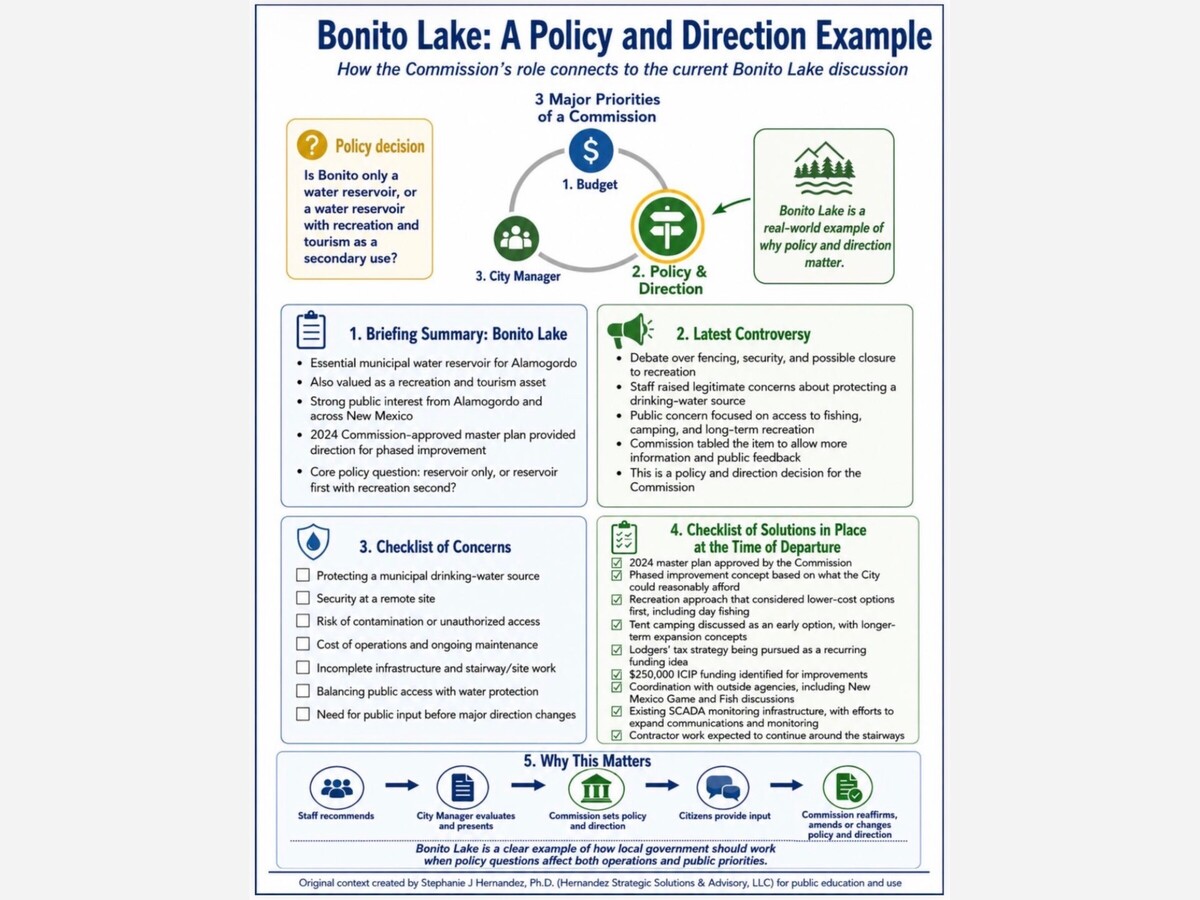
I recently wrote about what I believe should be the priorities of a City Commission. After the budget, my second priority was policy and direction. The current discussion surrounding Bonito Lake is a good example of why that responsibility matters and how the different pieces of municipal government are supposed to work together.
In our form of government, the City Manager works for the City Commission. The manager's responsibility is to provide the Commission with the best professional advice based available information, staff recommendations, financial considerations, operational realities and professional judgment.
City staff report through the City Manager. Department directors are the subject-matter experts in their areas, and their knowledge is invaluable. But regardless of where an idea begins, with a director, an employee, the City Manager, or citizen, the decision to move forward belongs to the City Manager. Staff then has the responsibility to present and support the recommendation and bring forward.
The Commission has a different role. Commissioners must consider the professional advice of staff, but they must also listen to the citizens they represent. Sometimes those two perspectives will align perfectly. Sometimes they do not. The Commission weighs both and establishes policy and direction.
That brings us to Bonito Lake. In 2024, the City Commission approved a master plan that included a direction for Bonito Lake. That approval gave staff the roadmap.
Master plans should never be treated as documents that are written, approved and placed permanently on a shelf. They are a living document. Conditions change. Costs change. Opportunities change. Community priorities can change.
The current discussion is not necessarily about whether someone was right or wrong in 2024 or whether someone is right or wrong today. It is an opportunity for the Commission to decide whether the policy direction it previously established remains the direction the community wants.
The fundamental policy question is simple: Is Bonito Lake strictly a municipal water reservoir, or is it primarily a water reservoir with recreation as an important secondary use?
That is a policy decision.
I believe the Commission made a smart decision when it tabled the item rather than immediately taking final action. Tabling gives commissioners time to obtain additional information, but more importantly, it gives the citizens an opportunity to tell them what you want.
When I began receiving text messages about the issue, I went back and watched the meeting. I am not surprised by the public response.
When we filled Bonito Lake, I received calls from people across New Mexico asking when fishing and camping would reopen. We were not ready to reopen the campgrounds but believed there were things we could do to allow day-fishing.
When the lake was stocked and we were preparing to open fishing in May, the fire interrupted those plans. Once the fire was contained, the calls started again: When are you opening Bonito for fishing?
Former City Manager Rick Holden received inquiries as well, including calls from legislators all over New Mexico. I continued receiving questions about when additional camping opportunities might return.
People have an emotional attachment to it the recreational value extends beyond Alamogordo.
Where things stood when I left
I want to be particularly careful here. I am no longer involved in City operations, and I do not know what has occurred since I left. I cannot speak to administrative decisions. I can only speak to where things were, to the best of my recollection, when I was City Manager.
Parks and Recreation Director Bass was following the master plan because that was the approved direction.
I remember discussions about beginning with lower-cost, more natural camping opportunities such as tent camping and gradually developing additional recreational opportunities, potentially including an RV area below the lake. I do not remember every detail of the plan. What I do remember clearly was the philosophy: we did not have enough money to do everything, but that did not mean we could do nothing. That was my overall concept regarding every department. We had to keep moving.
Start with what we could reasonably afford. Improve it over time. Follow the master plan. Work with stakeholders and pursue partnerships that could help stretch limited City resources. At the time, outdoor recreation and tourism were priorities at the state level, creating opportunities to work with state agencies on grants or partnerships to move the master plan forward over time.
Truthfully, that is how we approached quality-of-life improvements throughout the City.
For Bonito, my focus was finding a recurring funding source through lodgers' tax. Director Bass, Erik and others were working on different pieces of the overall plan. One of the strengths of the City's department directors was their passion in their field. As City Manager, I depended on them to identify opportunities and bring forward solutions.
I recalled the $250,000 ICIP funding that has recently been discussed. We made a deliberate effort to place quality-of-life projects into the City's capital planning when possible. That approach helped fund improvements throughout our parks, zoo and recreational facilities.
I remember Director Bass had discussions involving New Mexico Game and Fish and know that I approved moving certain discussions forward and a review of the proposed contract. The directors were able to give feedback. What happened after that, I cannot say.
I had forgotten There was also a contractor who was expected to complete additional work around the stairways. Again, I left before that process was completed, so I cannot responsibly say where that work stands today.
Those are items the current administration can answer much better than I can.
What about the security concern?
One massive concern raised by staff deserves serious treatment. Protecting a municipal drinking water source is always a legitimate concern.Security was something I worried about constantly as City Manager.
One of my recurring nightmares was whether we were prepared for a major train derailment involving hazardous materials. The railroad runs directly through our community and business district. The chiefs were probably tired of my constant questions about scenarios I had developed in my mind and whether we were prepared for them. Some were low probability but potentially high consequence events. I wanted us thinking about those risks before an emergency occurred, not during one. That is how emergency management works. You do not ignore a risk simply because it is unlikely. The same principle should apply at Bonito.
Identifying a risk does not automatically dictate one particular policy response. Security should be layered because no single security measure can make a critical water source completely secure. A fence can establish a boundary, discourage casual entry and delay unauthorized access. Those are legitimate benefits. But a chain-link fence by itself should not be confused with a comprehensive security system.
Protecting critical infrastructure generally requires multiple safeguards, including controlled access, monitoring, cameras, alarms, water quality testing, communications, operational procedures and an emergency response plan.
Bonito already has monitoring infrastructure, including SCADA and the City had been working on expanding communications and monitoring capabilities.
The approximately 80-mile distance between Bonito Lake and Alamogordo should also be discussed accurately. Distance does not eliminate the risk of contamination, and I would never suggest that it does. However, the conveyance and treatment process can provide something extremely valuable in an emergency: time. That is a much stronger security conversation than simply asking whether there is a fence.
There may also be another part of the solution: people. One reason I advocated changing the state lodgers' tax law so Alamogordo could use a portion of its tourism-related revenue for Bonito Lake operations.
If that legislation passed and then reestablished in Alamogordo, 60% of that recurring revenue could potentially support operations.
One option worth considering would be an on-site employee or caretaker presence at Bonito Lake, similar in concept to the landfill. An employee presence would not replace cameras, alarms, testing or other security measures. It would add another layer. Someone regularly on the property can identify problems, report suspicious activity, address maintenance issues, communicate quickly with Alamogordo and initiate established emergency procedures while additional personnel are responding.
That improves recreation and security at the same time.
Now the decision belongs to the Commission and to the public.
Staff has an obligation to tell the Commission what it believes is operationally best. The City Manager has an obligation to evaluate that information and make a professional recommendation.
Citizens have every right to say, we understand the recommendation, but this community values something different. Then the Commission has to weigh both.
That is not government dysfunction. That is exactly how representative local government is supposed to work and aligns with my overall discussion on priorities
The question before Alamogordo should not be framed as water versus recreation. Protecting our water supply must remain the first priority.
The better question is whether those two purposes can responsibly coexist:
Bonito Lake first as an essential water resource, and second as a recreational and quality-of-life asset belonging to the people of Alamogordo.
In 2024, the Commission gave staff one direction. Today, the Commission has the obligation to reaffirm it, modify it or establish a new one.
Because ultimately, staff recommends, the City Manager manages, the Commission sets policy and the Commission answers to you.

My family has been fishing and hiking around Bonito lake for well over 60 years we were very saddened when It was closed after the little bear fire but very happy when it opened. It should never be closed to recreational fishing and camping.
On the other hand, I realize that the city struggles to fund as many projects as they would like but I would like to add a thought that might help. If I have it right the DOD and HAFB partially fund the Bonito lake. At one point I was told that most of the water went to Holloman. So why not get a bunch of volunteers from the base as well as local citizens the rehab the crumbling access points around the lake. Mostly they are made from railroad ties with packed gravel to form steps. So it shouldn’t cost too much to at least make access safer.
the F4 project used countless hours of air force volunteers to get that job done thanks largely in part to one of the great leaders in our community, Mr Christopher Calhoun. Thank you,
Mark Werner


Sunny, with a high of 81 and low of 67 degrees. Sunny in the morning, clear in the afternoon and evening, overcast overnight.



glad there is fine weather for these events, and pleased to see this feather in ruidoso's cap.