
 78° and Heavy rain at times
Image
As Blackstone Merger Hearing Nears, a Closer Look at the Fund Keeping Otero County Neighbors Warm and Lit - 2nd Life Media Alamogordo Town News



Alamogordo, N.M - With the New Mexico Public Regulation Commission’s public comment hearing on the proposed Blackstone acquisition of PNM’s parent company set for Tuesday, July 28, Alamogordo Town News is taking a closer look at one program with real, measurable impact in our community: the PNM Good Neighbor Fund. It’s also an opportunity — one we believe Otero County residents shouldn’t let pass — to press Blackstone and the state’s largest energy consumers to put more skin in the game.
A Lifeline, Not a Handout
The Good Neighbor Fund is an emergency utility assistance program built on a simple idea — neighbors helping neighbors. It helps income-qualified PNM customers avoid disconnection and maintain electric service during times of financial hardship, working through community-based nonprofit partners across New Mexico.
Unlike many utility assistance programs that only operate seasonally, the Good Neighbor Fund runs year-round. To qualify, customers generally must be receiving LIHEAP or SNAP benefits and have a past-due balance or disconnect notice. Residents age 60 and older who meet income requirements may qualify even without a past-due balance or disconnect notice — a provision that matters in a county like ours, where elderly and disabled residents often live on fixed incomes with limited access to other services.
The Local Picture: Small Slice of Customers, Bigger Slice of Help
Here’s a number worth sitting with. Of PNM’s roughly 502,000 residential customers statewide, Alamogordo accounts for about 17,245 of them — roughly 3.4% of PNM’s total residential customer base, according to the company’s own geographic customer breakdown. Yet Love INC, the Alamogordo nonprofit that administers the fund locally, and has for over 15 years for free, with no administrative rebate or staff allowance; is allocated four grant awards a month, or about 10% of the program’s monthly statewide total — nearly three times Alamogordo’s proportional share of customers.
That’s not an accident. When PNM designed its current monthly allocation formula, it weighed both the percentage of customers by location and historical grant-utilization patterns at each partner agency, and it says that approach produced a larger allotment for agencies outside the Albuquerque/Santa Fe metro than either a strict population-based or a county-donation-based formula would have. PNM has said it tested those alternative methods and found they would have left several non-metro provider locations — Alamogordo very likely among them — with smaller allocations than they receive today.
It’s a rare instance of a rural community coming out ahead of the math, ever so slightly, and it’s worth acknowledging. It also means Otero County has more riding on the fund’s health than its customer count alone would suggest, and more reason to want to see it grow rather than shrink.
A Decade of Need, in the Numbers
Company data shared with partner agencies this month shows just how much the program’s caseload has swung over the past several years:
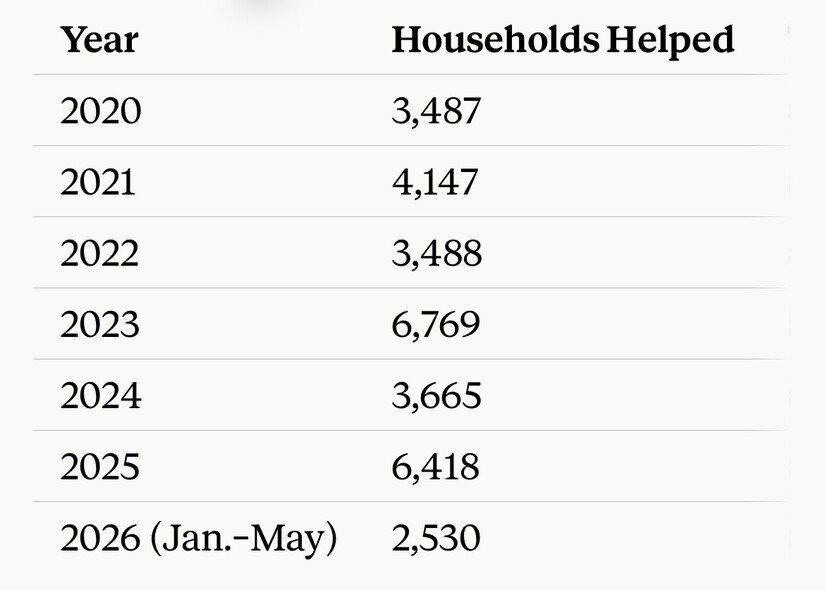
The 2023 spike reflects a period when PNM was drawing down a carried-forward balance built up from prior “bonus” shareholder contributions, including dollars added during the COVID-19 pandemic. By 2024, that cushion was largely spent, and both the caseload and total dollars awarded dropped back toward pre-pandemic levels. 2025’s rebound came from two deliberate moves: raising the standard grant from $75 to $175, and shareholders’ agreement to inject an additional $1.5 million into the fund as part of a settlement in PNM’s rate case, meant to supplement base funding from July 2025 through June 2028.
Even that wasn’t enough to keep pace with 2026. Month-by-month figures show the fund helped 738 families in January alone, then 561 in February, 553 in March, 363 in April and 282 in May — nearly 2,500 families and roughly $436,000 in assistance in the year’s first five months, a pace that outstrips what the fund distributed across some entire prior years. That crush of demand is what prompted PNM to introduce monthly allocation caps this July — a change the company describes not as a reduction in annual assistance, but as an attempt to keep help available in every month rather than see the fund run dry by autumn.
How It’s Funded
The program runs on voluntary contributions from PNM customers, employees, and shareholders. In a typical year, the fund takes in roughly $400,000: about $200,000 from customer and employee donations, matched by an annual $200,000 shareholder contribution. PNM has continued that $200,000 match even in years when customer and employee giving fell short of its historical average — and, as the numbers above show, has leaned on additional one-time shareholder contributions to meet spikes in need.
A Second Tool Sitting Unused: Income-Based Rates
The Good Neighbor Fund isn’t the only mechanism available to ease the burden on struggling households — it’s just the only one currently in use.
In 2025, the New Mexico Legislature passed House Bill 91, the Public Utility Rate Structure Act, which lets investor-owned utilities like PNM design and propose income-tiered or low-income discount rate programs for PRC approval.
(Note: Alamogordo House Rep District 51 Representative, John Block voted against this measure, as did Senator Townsend, nay, to assist in rate relief for the economically challenged.)
The law doesn’t create a discounted rate on its own — it simply opens the door for a utility to bring one forward. More than 20 other states, including neighboring Arizona and Colorado, already have some form of income-based utility rate in place.
More than a year after that bill became law, no New Mexico utility, PNM included, has yet filed such a proposal with the Commission.
PNM representatives, on a Tuesday phone call with this reporter, have indicated the company intends to bring a version of an income-graduated rate structure to the PRC in the future as another tool to ease the strain on elderly and economically challenged customers’ bills — but as of this writing, no formal application has been filed, and no timeline has been made public.
That gap matters. A discounted base rate would work differently than the Good Neighbor Fund — it wouldn’t require a customer to already be behind on their bill or facing a shutoff notice, and it would lower the cost of power every month rather than providing an emergency, one-time grant.
For a fixed-income retiree in Otero County, that’s the difference between crisis intervention and everyday relief.
As Alamogordo Town News continues to press Blackstone and large energy users to fund emergency assistance, we’re also asking PNM to put a real filing date on the table for the low-income rate tool state lawmakers already gave it.
What Blackstone Has Put on the Table — and Our Challenge
As part of the proposed acquisition, Blackstone Infrastructure has pledged $10 million to the Good Neighbor Fund over ten years — about $1 million annually. That commitment sits inside a broader package the companies say totals $175 million in community support and a $105 million customer rate credit, contingent on the deal closing.
A million dollars a year is real money, and roughly two and a half times the fund’s normal annual shareholder contribution today. But this is an $11.5 billion transaction, one that would hand control of New Mexico’s largest electric utility to a private equity firm — and one that has already drawn unusually intense regulatory scrutiny.
Just weeks ago, state regulators ruled that PNM and Blackstone-affiliated entities violated New Mexico law with an unauthorized $400 million stock transaction tied to the deal, and ordered it unwound at shareholder expense.
That kind of finding should make everyone ask harder questions about what the companies are offering New Mexicans in return for approval.
Alamogordo Town News believes Blackstone can and should double its Good Neighbor Fund commitment to $2 Million annually.
And we’re calling on other large corporations and major energy consumers doing business in New Mexico — the industrial users, the data centers, the big commercial ratepayers who keep the grid humming and profit from it — to step up their own giving, so the fund can better serve rural counties like Otero, where poverty rates run higher, where elderly and disabled residents have fewer resources to fall back on, and where today’s economic pressures are felt as sharply as anywhere in the state.
Make Your Voice Heard — July 28
The good news: New Mexicans don’t have to wait for boardrooms to decide this.
The Public Regulation Commission has scheduled a public comment hearing for Tuesday, July 28, 2026, from 1:00 to 7:00 p.m. at the University of New Mexico Student Union Building, Ballroom C, in Albuquerque, under Docket No. 25-00060-UT. This is the public’s chance to speak directly to the regulators who will decide whether this merger — and the community commitments attached to it — moves forwarD.
• Speak in person: Attend the July 28 hearing and sign in at the entrance; no advance sign-up is required, and speakers are generally given up to three minutes. Full details are in the official PRC notice.
• Submit written comment any time: File electronically through the PRC’s e360 portal, referencing Docket No. 25-00060-UT.
• Follow the case: Review filings and background at the PRC’s case information page.
• Accessibility accommodations: Contact the PRC Consumer Relations Division at (505) 827-8019.
If you show up, or if you write in, say something about the Good Neighbor Fund.
Tell the commissioners that a $1-million-a-year pledge is a floor, not a ceiling, for a company about to profit from owning New Mexico’s power grid.
Ask them to hold Blackstone — and every large energy consumer benefiting from this system — to a higher standard of giving back to the communities that keep the lights on for their operations in the first place.
Neighbors and Communities
This isn’t an abstract policy discussion. It’s about whether a grandmother on a fixed income in La Luz can keep her lights on through August. It’s about whether a disabled veteran in Tularosa gets a phone call back from Love INC before his disconnect notice becomes a disconnection.
Rural New Mexico has spent a decade proving it will step up for its own — through pandemic-era donations, through a program that, dollar for dollar, already sends more help to Alamogordo than our customer count alone would justify. Neighbors have carried this fund.
As the ownership of our electric utility potentially changes hands for $11.5 billion, it is not too much to ask the incoming owners, and every large enterprise drawing power off this grid, to carry more of the weight too and show more support for the more rural and economically challenged areas of the state.
Show up on July 28. Write in before then. And when Blackstone talks about “community investment,” hold them to a number that actually matches the size of the deal they’re asking New Mexico to approve.
Back to the Good Neighbor Fund: Community members, employees, and businesses can donate to the PNM Good Neighbor Fund at pnm.com/gnfgiving.
Let’s build a better a better community together supporting one neighbor at a time with a lifeline not a hand put.
- 2nd Life Media Alamogordo Town News Special Report by Journalist Chris Edwards.


Just thought the one thing all these first-timers have in common is no qualifications. Wanting to serve, help, or partake isn't enough. None of these people have any professional experience. Where are the engineers, CPA's, Ph.D's?
Business owners, a practicing attorney, one with a PHD, seems to me you didn't review the video.

Sunny, with a high of 78 and low of 63 degrees. Sunny during the morning, patchy rain nearby in the afternoon, clear for the evening,


like many others, i have experienced work-place environments where favoritism and cliques were present - adding unnecessary stresses to any job. two observations about such places; that the ultimate goal of governmental ethics regulations is to prevent the appearance of imp
Just to weigh in on this. Whatever the editor thinks about his right to publish is certainly his point of view, but it's getting to the embarrassing stage of conjuring divisiveness bent on turning a functioning government he doesn't like, but the people have elected.
The editors point of view is we need a functioning government. The viewpoint allegations were not of the editors making it was mailed to the city with a copy to the editor.
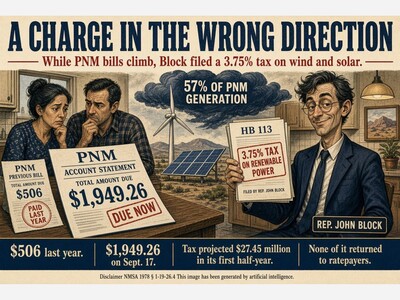
like 99% of his fellow republicans, block is a servant to the oil & gas industry - a principal constituent of their party.


i would say that while our economy is "the hottest in the world" according to el presidente, this would be an excellent time for block to seek employment in the private sector....just like barela.
Pipqueak is a prime example of the defects of their party. They don't recruit qualified leaders. It's duplicitous, unemployed people who know all they have to do is start an internet site and walk the neighborhood dressed up on Sundays. The population here doesn't know how to vote.

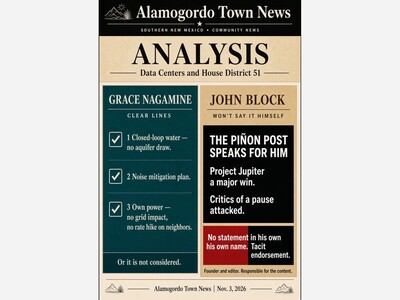
It is so important to understand the differences in the candidates' stand on this critical issue! Protecting our water in the desert is understood by all political parties living here! Nagamine is taking a stand to protect us!
many politicians claim to represent common sense, but here in new mexico, defending our water supplies and electrical power generation is pretty much the definition of common sense - and sucking up to billionaires is not.