
 61° and Clear
Image
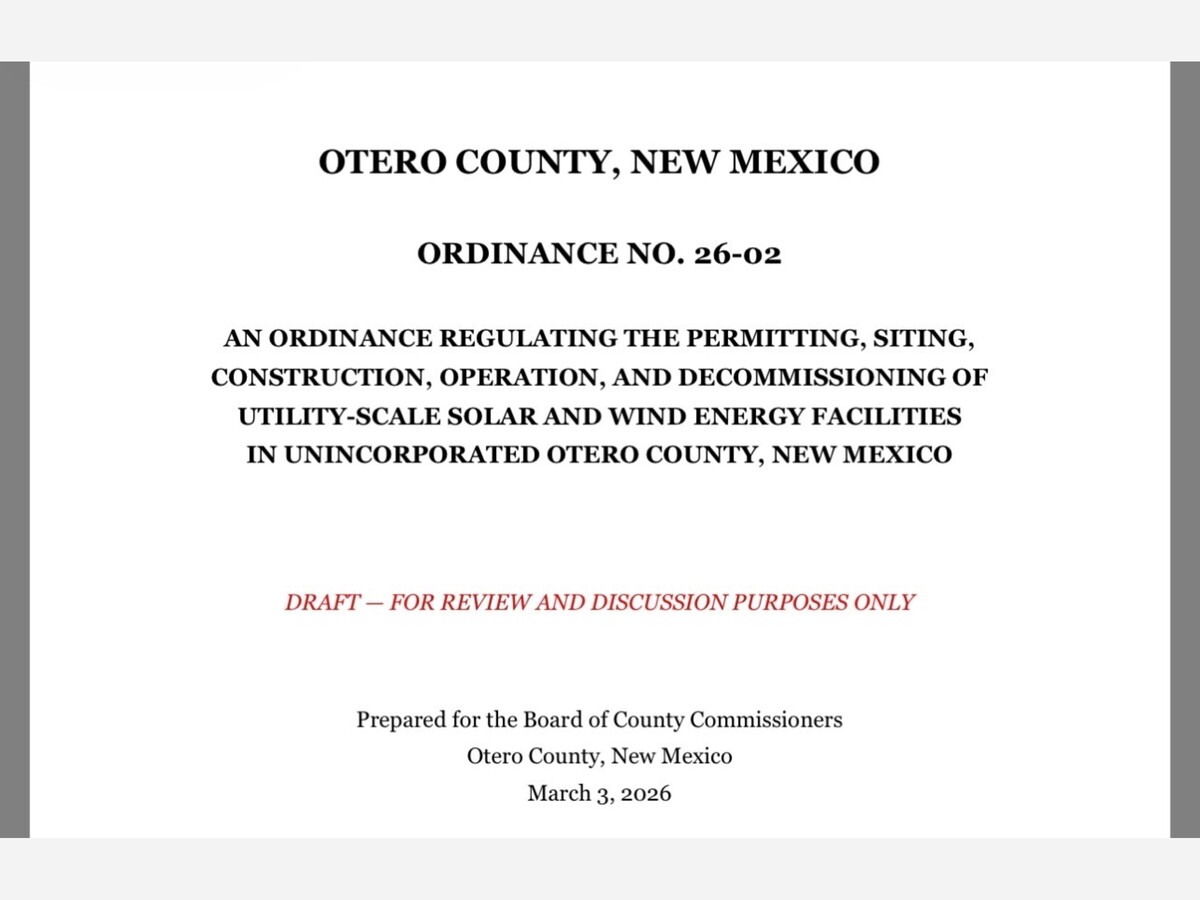



Alamogordo, NM – March 12, 2026 – As New Mexico accelerates toward its ambitious goal of 100% carbon-free electricity by 2045 under the Energy Transition Act, Otero County is stepping up with a proposed ordinance to manage the siting, construction, and decommissioning of large-scale solar and wind projects in its unincorporated areas. The draft, prepared for the Board of County Commissioners and set for a public hearing, aims to balance economic opportunities from renewables with protections for local agriculture, water resources, wildlife, and community welfare. While similar to regulations in counties like Santa Fe and Grant, Otero’s measure stands out for its police-power basis in a county without comprehensive zoning, highlighting a patchwork of local approaches across the state.
The 22-page draft ordinance, titled “Otero County Renewable Energy Facility Ordinance No. 26-02,” requires permits for utility-scale facilities—defined as solar projects exceeding 5 megawatts (MW) or 25 acres, wind farms over 1 MW total capacity, and standalone battery storage systems of 5 MW or more. Key provisions include mandatory setbacks (e.g., 1 mile from occupied structures for wind turbines, half-mile for solar), height limits (600 feet for wind, 20 feet for solar), noise and shadow flicker restrictions, visual screening, wildlife corridors, and robust decommissioning plans with financial assurances like bonds or letters of credit. Applicants must submit detailed studies on water use, traffic, and environmental impacts, with fees starting at $10,000 plus escrow for third-party reviews.
Enacted under the county’s general police powers per NMSA 1978 §§ 4-37-1 to 4-37-3, the ordinance explicitly avoids zoning classification and applies uniformly countywide. It exempts small-scale systems (under 1 MW for on-site use) and respects state preemptions, such as the New Mexico Solar Rights Act, which prohibits unreasonable restrictions on solar installations. Violations could result in fines up to $300 per day, stop-work orders, or permit revocation, with appeals to district court.
Why Ordinance Proponents Encourage this Ordinance
County officials argue the measure is essential to address potential adverse effects from burgeoning renewable development, driven by state mandates like the Renewable Portfolio Standard (RPS)—requiring investor-owned utilities to hit 50% renewables by 2030 and 100% carbon-free by 2045. Otero, home to vast open lands near White Sands National Park and Holloman Air Force Base, lacks zoning ordinances, leaving it vulnerable to unregulated projects that could strain infrastructure, deplete water in an arid region, or disrupt scenic and agricultural values. “This isn’t about prohibiting renewables,” the draft’s recitals state, “but establishing reasonable conditions” to safeguard residents while aligning with state policies like the Energy Transition Act.
Recent interest in repurposing facilities like the Otero County Prison for data centers—potentially powered by renewables—underscores the need for clear guidelines. Without them, conflicts could arise, as seen in other rural areas where large projects have sparked debates over land use and community benefits.
How It Compares to Other New Mexico Counties
New Mexico’s siting authority is largely local for projects under 300 MW, shifting to the state Public Regulation Commission (PRC) for larger ones, which can preempt “unreasonably restrictive” local rules. This hybrid model—common in 27 states—leaves counties to craft their own standards, resulting in varied approaches. Otero’s draft mirrors elements in Santa Fe County’s supplemental zoning standards, which impose height limits (90 feet for small wind, with stealth designs), setbacks, and fire code compliance for wind facilities. Both emphasize environmental mitigation, but Santa Fe’s integrate into existing zoning, unlike Otero’s standalone police-power framework.
In Grant County, officials discussed a similar ordinance in 2022 to regulate incoming solar and wind farms, starting with interim consultations before full policy development, driven by floodplain permitting gaps. Luna County, meanwhile, has supported solar through industrial revenue bonds (IRBs) for projects like the Carne Solar facility, with ordinances amending bonds rather than imposing strict siting rules. This contrasts with Otero’s more prescriptive requirements, such as mandatory wildlife studies and 1-mile wind setbacks, which could be seen as more restrictive.
Statewide, no uniform model ordinances exist for solar or wind, per a 2024 inventory of siting policies. However, the Solar Rights Act limits local bans on solar except in historic districts, a provision Otero honors. Compared to states like Arizona (state for solar thermal >100 MW) or California (>50 MW opt-in), New Mexico’s higher 300 MW threshold gives counties more control over most projects. Yet, local restrictions are rising nationwide, with counties in all 50 states imposing barriers like height limits or bans, often for utility-scale renewables.
Critics argue such ordinances could hinder state goals, but proponents like Otero officials see them as vital for tailored oversight. “We want responsible development,” said one commissioner during agenda discussions.
The ordinance’s discussion is for March 12th with adoption possible by late spring. Residents can review the draft on the county’s AgendaSuite portal - https://agendasuite.org/iip/otero/file/getfile/32781
. As renewables expand—with over 2,500 MW under lease on state trust lands—Otero’s move could set a precedent for rural counties balancing growth and preservation. For updates, visit the Otero County website or tune into KALHRadio.org and AlamogordoTownNews.org

I follow theatres across the county, and know, this report is very sparse with details. Impossilbe to spend a million dollars on removing a fly loft, rigging and weights. New roof . . other upgrades, no where near a million bucks. The defamation should be on the managers who awarded inexperienced developers.
2nd Life Media is not an owner. We sold our share and that owner sold it to the present owner. Might want to check your facts. Also LEDA requires receipts and documentation. We had an estimated when we were an owner of aproximately $3 million needed to make it operational. Check your facts.
It will take well over a million dollars to make the theater usable to the public. We have not yet spent a million dollars, but we are far from complete. Our projected open date is Summer/Fall 2027.

Sunny, with a high of 79 and low of 59 degrees. Patchy rain nearby in the morning, clear in the afternoon and evening,





another useful example of a politician who is financed almost completely by special interests rather than the folks he's supposed to be representing. he represents the interests of those who pay his way...and only appeals to his voters when it comes time for re-election.


For those of the civilian public to understand. Every single Airman, marine, sailor and soldier whether Active duty or reserve or national guard has had explicit training on the UCMJ and illegal orders. This includes every “veteran for peace” It is political plain and simple.
regrettably, it might be necessary in the days of numerous respected/high ranking/decorated military leaders being fired/demoted/forced into early retirements when they fail to meet the specifications of glorious generalissimo hairgel - grapevine seems to indicate that dear leader is tiring of his various antics - e

Received that crime flyer in the mail today. Wow! Mudslinging V2.0 by the blockheads as usual.