50° and Clear

RPNM's Frozen SCC List: Who Gets to Vote, Who Holds Multiple Seats, and Is the Quorum Really 366?


An opinion by Gary Person on election law, party rules, and transparency ahead of the January 9, 2027 state officer elections.
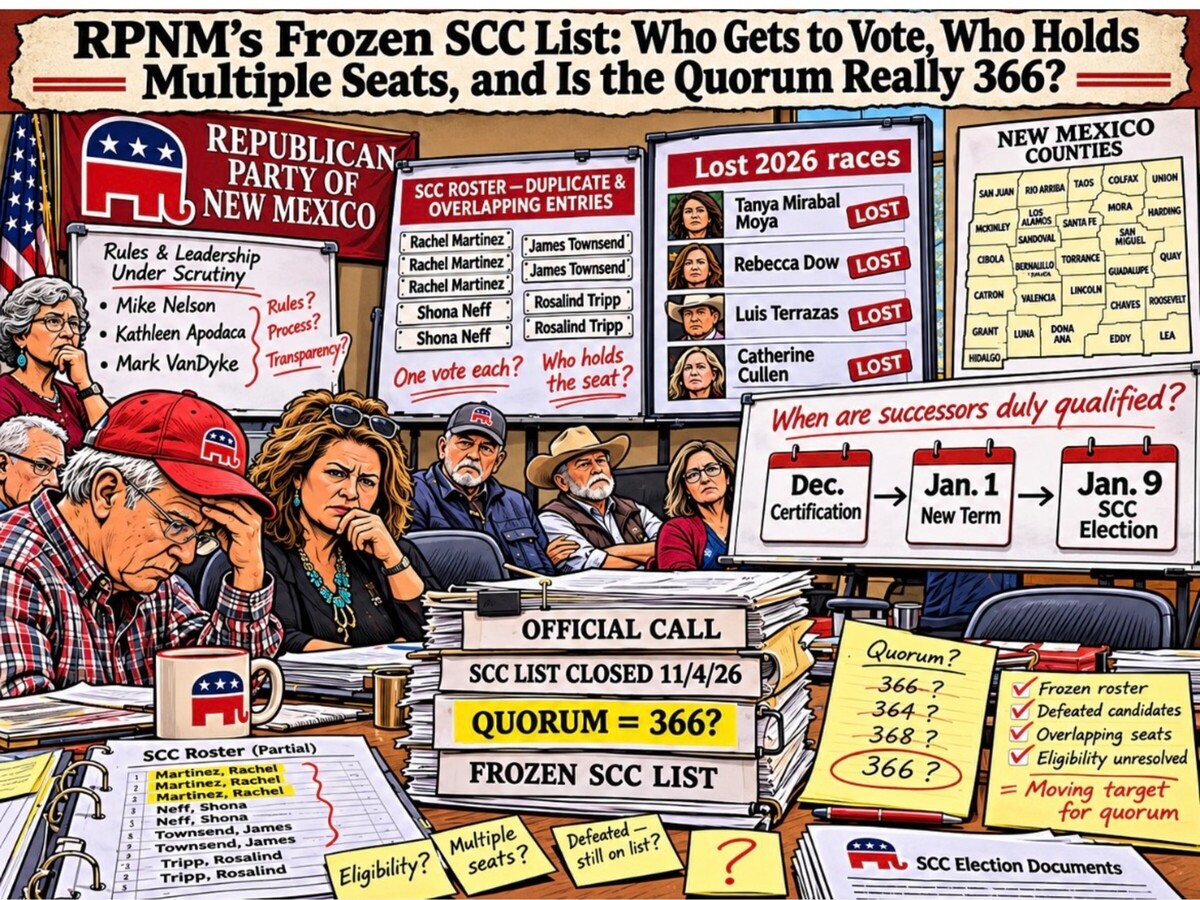
The Republican Party of New Mexico has announced that its State Central Committee (SCC) membership list was frozen November 4, 2026, and that 366 members are required for quorum at the January 9, 2027 state officer elections.
But after reviewing the 2026 election results, the SCC roster, and RPNM's own Uniform State Rules, a serious question emerges: How can the party confidently declare a fixed quorum when the eligibility of several members may change before the meeting?
There are four defeated Republican legislators, multiple individuals listed under more than one SCC position, and unresolved questions about when public officeholders legally cease to qualify for ex officio membership.
These issues deserve answers before ballots are distributed.
Four Defeated Legislators — Four Questions About Voting Rights
The November 3 election resulted in the defeat of four incumbent Republican state representatives:
- Tanya Mirabal Moya, House District 7,
- Rebecca Dow, House District 38,
- Luis Terrazas, House District 39,
- Catherine Cullen, House District 57,
All four appear on RPNM's September 30 SCC membership roster as ex officio members, based on their service in the New Mexico House of Representatives.
Under RPNM Uniform State Rule 2-1-3(A)(8)(f), incumbent Republican members of the New Mexico House qualify for SCC membership.
But what happens when they are no longer incumbent legislators?
That is where New Mexico law becomes particularly important.
What Does "Duly Qualified" Actually Mean?
The New Mexico Constitution establishes three important requirements.
Article XX, Section 1 requires elected officers to take and subscribe an oath before performing official duties.
Article XX, Section 2 provides that an officer remains in office until a successor has duly qualified.
Article XX, Section 3(A) establishes January 1 as the beginning of regular terms following the election.
Certification of election results, receiving a certificate of election, and becoming duly qualified are not necessarily the same legal event.
The 2026 election is scheduled for certification in November, with certificates of election scheduled for December 4. Yet the incoming legislative term does not begin until January 1.
So here is the question RPNM needs to answer:
If the four incoming Democratic representatives take their required oaths on December 31 and are otherwise qualified to assume office January 1, does that end the outgoing Republicans' ex officio membership before January 9?
Or, if those incoming representatives do not take their oaths until the Legislature convenes January 19, could the defeated Republicans remain in office under the constitutional holdover provision and retain SCC voting eligibility on January 9?
January 19 is the scheduled opening of the legislative session, not necessarily the date every incoming representative must qualify.
The precise dates of qualification must be established through official records.
RPNM should not assume that certification alone ends an incumbent's service, nor should it assume that the opening of the legislative session automatically determines when a successor becomes qualified.
How Can RPNM Freeze the SCC List on November 4?
The Official Call states:
"SCC LIST CLOSED 11/4/26 Quorum = 366"
Rule 1-3-1(B)(i) prohibits modification of the SCC membership list after an official meeting call is issued until that meeting concludes.
But Rule 2-1-3(A)(8)(f) ties legislative ex officio membership to being an incumbent Republican legislator.
This creates an obvious question about how RPNM intends to reconcile two rules.
If the four defeated Republicans cease to hold office before January 9, will RPNM still permit them to vote because their names were on the November 4 frozen list?
If their legislative qualifications expire, will the SCC remove their votes from the eligible membership calculation?
And if new Republican legislators assume office January 1, will those newly qualified ex officio members be excluded merely because their names were not on the November 4 list?
For example, Republican Heather Scott Ellison won House District 4 in November. Her incoming legislative status raises the opposite side of the same question.
The September roster also lists Andrea Reeb as an incumbent representative, although she resigned her legislative position in October. Was that change properly reflected before the November 4 freeze?
A frozen administrative roster and an individual's continuing legal eligibility are not necessarily identical. RPNM must explain which interpretation it is applying.
Why Are Some Individuals Listed Multiple Times?
The SCC roster raises another question about the distinction between holding multiple positions and having multiple SCC memberships.
RPNM Rule 2-1-3(B) provides for SCC membership through only one qualifying method, while Rule 2-1-3(D) allows each SCC member one vote.
The September 30 roster identifies:
NamePositions appearing on the SCC rosterRachel MartinezRPNM Second Vice-Chair, State Finance Committee Chair, Bernalillo County SCC Member #64Shona NeffRPNM Congressional District 2 Vice-Chair, Doña Ana County SCC Member #16James TownsendRepublican National Committeeman, New Mexico Senator District 34Rosalind TrippFormer Republican National Committeewoman, Socorro County Treasurer
The roster marks one entry for each individual with a Q value of 1 and the additional entries with 0.
That suggests RPNM is attempting to prevent duplicate counting.
But preventing multiple votes does not fully answer whether someone should continue occupying more than one SCC position.
If an individual already qualifies through an ex officio position, what happens to an elected county SCC position also listed under that individual's name?
Can someone else represent that county through the elected position?
Or can the same person continue occupying the additional position indefinitely, even if it does not provide another vote?
These are distinct questions that deserve answers.
Rachel Martinez: Three Positions, One Vote — But What About Representation?
Rachel Martinez presents the clearest example.
She appears three times in the September SCC roster:
- RPNM Second Vice-Chair — ex officio, marked Q = 1.
- State Finance Committee Chair — ex officio, marked Q = 0.
- Bernalillo County SCC Member #64— marked Q = 0.
RPNM's position that she receives only one vote is consistent with the one-vote rule and the roster's Q markings.
But the more important question concerns representation.
Why does Rachel Martinez remain listed in three SCC positions when the Uniform State Rules provide for membership through only one qualifying method?
If the Bernalillo County position is not being counted as her voting membership, is that position still considered occupied?
Has another qualified Republican requested the opportunity to serve in that position?
Has Martinez declined to relinquish it, and if so, what rule permits the position to remain under her name?
Those questions require documentary answers. The roster itself does not establish that she refused a request to step aside or that a replacement was improperly denied.
Nevertheless, if an elected county SCC position is being held under a non-counting entry, RPNM should explain whether that position is available to another qualified Republican and, if not, why not.
The same principle warrants examination for Shona Neff and Rosalind Tripp, who also have county positions marked Q = 0.
James Townsend's two ex officio qualifications raise the related question of how the party records and counts overlapping sources of membership.
One vote per person is clear. What constitutes one legally occupied SCC position deserves equal clarity.
The Real Problem: Is 366 an Accurate Quorum?
Rule 2-1-5(C) requires two-thirds of SCC members representing two-thirds of New Mexico's 33 counties to establish quorum.
That means the SCC must satisfy both the numerical requirement and representation from at least 22 counties.
Yet RPNM declared a quorum of 366 when the Official Call was issued November 4.
Since then, the scheduled transition of elected public offices presents several unresolved eligibility questions.
The four defeated Republican representatives may cease qualifying as ex officio SCC members before January 9.Newly elected Republican legislators may become qualified. Additional SCC positions remain listed under individuals already counted through another method.
There is also the question of how 2026 gubernatorial election results affect future county SCC apportionment under Rule 2-1-3(A)(2), which bases elected representation on the last preceding gubernatorial election for which official canvass records are available.
That apportionment issue must be reconciled with the November 4 roster freeze rather than assumed to change the January 9 roster automatically.
The result is a disputed membership calculation.
A frozen roster may establish the list RPNM intends to use, but it does not, without further explanation, settle every question about legal eligibility, overlapping membership qualifications, or who may actually vote.
The quorum figure may remain administratively fixed under RPNM's interpretation of its rules. However, whether that figure accurately reflects qualified membership on January 9 remains unresolved.
Until RPNM explains these matters, the effective quorum is a moving target in dispute, even if the official announcement continues to say 366.
Where Is the Advisory State Rules Committee?
This is exactly the kind of rules-conformity issue that deserves a clear response from state party leadership.
Mark VanDyke, chairman of the Advisory State Rules Committee, should be asked for the committee's interpretation of the apparent conflict between the frozen SCC list and changing ex officio qualifications.
Mike Nelson, serving as acting state chairman, and Kathleen Apodaca, state secretary, should be asked to provide the approved roster, credentials procedures, and quorum calculation.
The Advisory State Rules Committee has defined duties under Rule 2-1-8(B), including reviewing the Uniform State Rules for conformity with law. That does not make it the final adjudicator of every election dispute, but its written analysis would help clarify the party's position.
The SCC itself remains the party's governing body.
The Questions Every SCC Member Deserves Answered
Before January 9, RPNM leadership should publicly explain:
- Whether the four defeated Republican legislators will retain ex officio voting rights, and how their successors' qualification dates will be verified.
- Whether newly qualified Republican legislators will be added to the electorate despite the November 4 freeze.
- Whether the multiple roster entries for Rachel Martinez, Shona Neff, James Townsend, and Rosalind Tripp occupy separate positions or merely document alternative qualifications.
- Whether any county SCC positions marked Q = 0 should be made available to other qualified members.
- How RPNM calculated the announced quorum of 366 and whether that figure accounts for all eligibility changes and county representation requirements.
None of these questions should be dismissed simply because the party already published an official call.
Transparency Should Come Before the Vote
New Mexico Republicans have already watched their party suffer significant election losses in 2026.
Now they face a state officer election in which the membership list is frozen, multiple people appear under more than one qualifying position, and four defeated legislators may or may not remain eligible to vote depending on when their successors become duly qualified.
RPNM has every opportunity to provide the records, explain the rules, and resolve these uncertainties before the election.
The SCC cannot confidently determine whether it has a lawful quorum without first determining who is legally entitled to be counted.
A published number is not a substitute for a transparent calculation.
Before RPNM elects its next leadership, it needs to answer a much simpler question: Who actually belongs to the State Central Committee on January 9, 2027, and how can the party prove it?
The credibility of the election depends on those answers.
Primary references: RPNM Uniform State Rules effective September 6, 2025, particularly Rules 1-3-1(B)(i), 2-1-3(A)–(D), 2-1-5(C) and 2-1-8(B); Q3 SCC Membership List dated September 30, 2026; November 4, 2026 Official Call; New Mexico Constitution, Article XX, Sections 1–3; New Mexico Secretary of State election and oath-of-office guidance.