
tom mitchell
Neighbor
4-14-2026 10:20am
I disagree with this
This is unverified
Spam
Offensive



Guest Opinion By Gary Person
There’s a passage from H. Beam Piper that feels uncomfortably relevant today:
"Every society rests on a barbarian base… The people who create nothing, and who don’t appreciate what others have created for them, and who think civilization is something that just exists… Responsibilities? Phooey! What do they have a party for?"
That line cuts to the heart of what happens when rules are treated as optional—and responsibility becomes someone else’s problem.
And that is exactly the issue now facing the Republican Party of New Mexico.
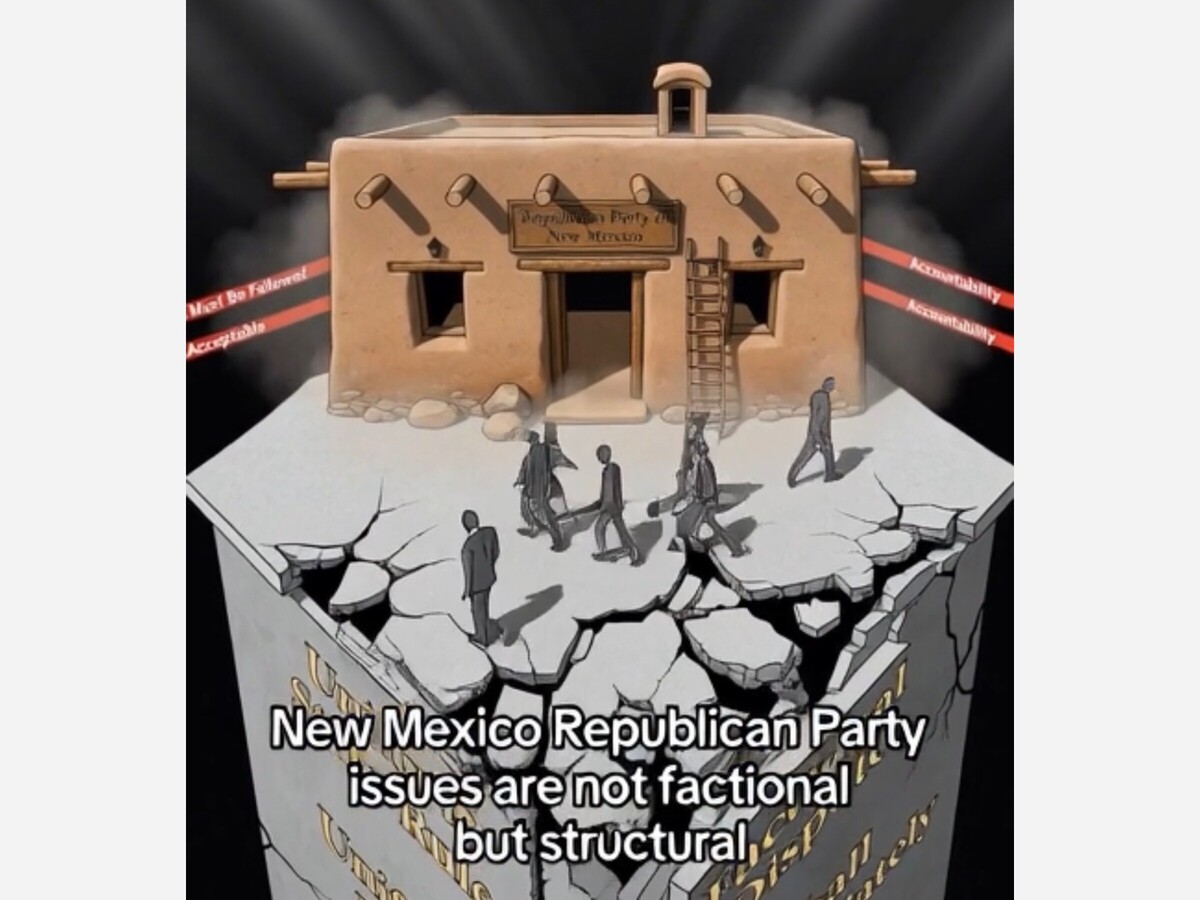
This is not a debate about personalities. It is not about factions. It is about whether the party is willing to follow its own rules.
Uniform State Rule 1-4-4 leaves little room for interpretation:
“In the event the state chairman or any other state officer of the Republican State Central Committee files as a candidate for public office and there is another Republican who has filed for the same office, the state officer shall immediately vacate the party office.”
“Shall immediately vacate” is not ambiguous. It is not discretionary. It is mandatory.
Yet instead of addressing whether this rule applies, the response has been to label those raising the issue as “factional.”
That argument does not hold up under the party’s own rules.
In fact, the rules already anticipate factional disputes—and they do not dismiss them. They assign responsibility for resolving them.
Uniform State Rule 2-1-2(B) states:
“The State Central Committee shall have the power to settle factional differences and to prevent damage to party welfare.”
And it goes further.
Uniform State Rule 2-1-2(D) provides:
“When the State Central Committee… finds that… any dispute involving factional differences is presented… it shall have the power to [act, including replacing officers or committees].”
In other words, calling something “factional” does not make it disappear. Under the rules, it triggers action by the State Central Committee.
More importantly, this situation is not fundamentally a factional dispute. It is a rules compliance issue.
The rules themselves make that clear. The Republican Party of New Mexico “shall be organized and governed in accordance with these Uniform State Rules,” and no rule can be suspended at the state or county level.
So the question is unavoidable:
If a rule says “shall immediately vacate,” and the condition has been met, can that rule simply be ignored?
Calling it “factional” does not answer that question.
It avoids it.
And avoidance is exactly what Piper warned about—the belief that institutions will function on their own, without accountability, without responsibility, and without adherence to the rules that give them structure.
But they won’t.
Rules only matter if they are followed. And they only have authority if they are applied consistently—especially when doing so is inconvenient.
The Republican Party of New Mexico has already defined the process for handling disputes, vacancies, and internal conflict. Members invoking those processes are not undermining the party. They are following it.
The real danger is not disagreement.
It is the idea that rules can be set aside—and that those who insist on following them can be dismissed with a label.
Because once that happens, the rules no longer govern the party.
People do.
And when that line is crossed, the damage isn’t factional.
It’s structural.
Alamogordo Town News will continue to monitor developments within the Republican Party of New Mexico and provide fair, fact-based coverage and guest commentary for Otero County residents and beyond. Stay tuned to KALH Radio and our site for update

Sunny, with a high of 71 and low of 55 degrees. Overcast in the morning, thundery outbreaks in nearby for the afternoon, clear in the evening, patchy rain nearby overnight.


Love your shop in Las Cruces! Haven’t been to the one here in Alamo yet.
Hi Troy,
What do you think of the manga Jaadugar: A Witch's Life in Mongol (Tomato Soup). It's now an anime from Saru Science/Crunchyroll.
Enjoy!



Thank you Sheriff!