59° and Patchy rain nearby
Image
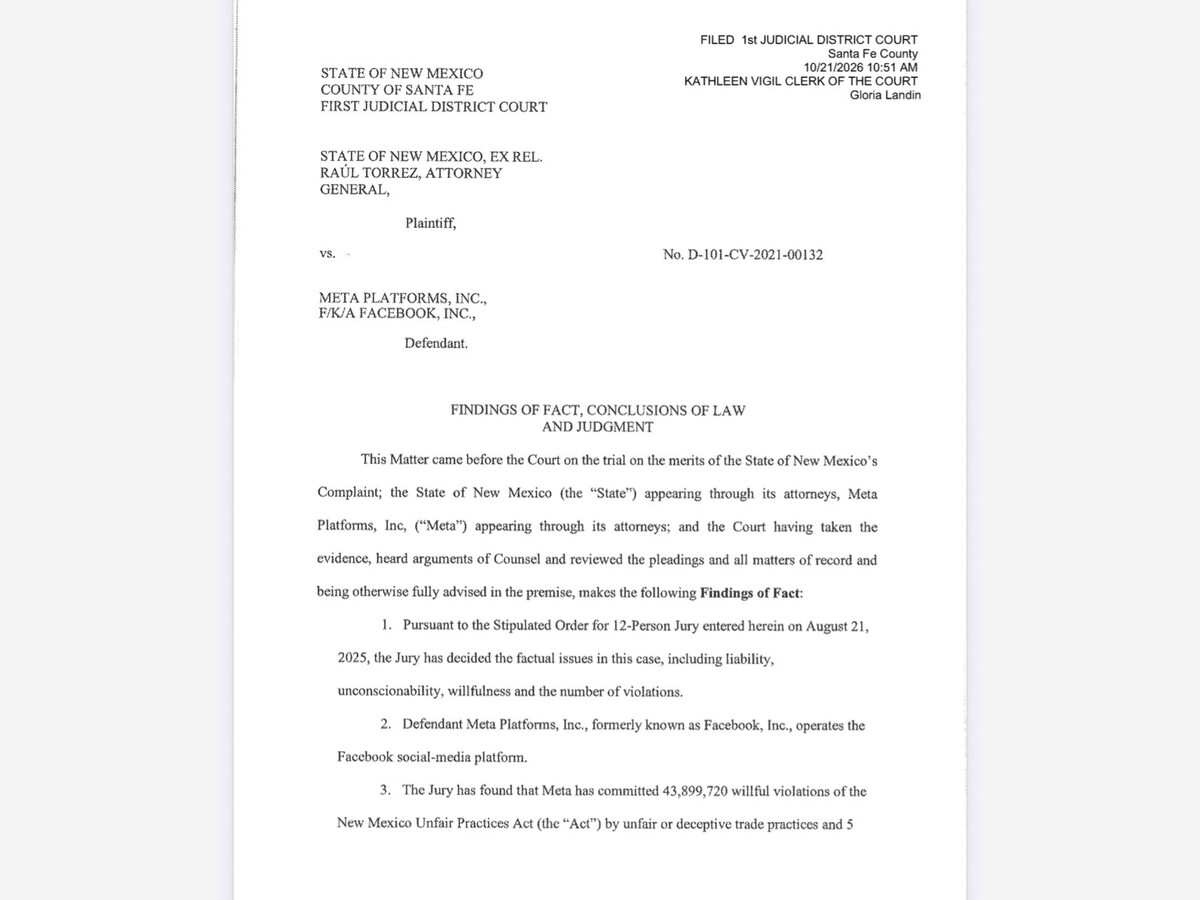



SANTA FE, N.M. — A New Mexico judge on Wednesday ordered Meta Platforms Inc. to pay a $25 billion civil penalty, concluding that the company formerly known as Facebook spent more than a decade misleading the public about how it handled users' data, policed misinformation and hate speech, and enforced its own rules.
First Judicial District Court Judge Francis J. Mathew found that the state was entitled to $219.5 billion under the maximum penalty allowed by the New Mexico Unfair Practices Act — $5,000 for each of 43,899,720 violations found by a jury — before reducing the award to $25 billion. The judgment, filed at 10:51 a.m., also orders interest to accrue at 15% a year until the penalty is paid in full. At that rate, interest alone would amount to roughly $3.75 billion a year.
The order does not explain how the court arrived at the $25 billion figure. The judge reserved a decision on injunctive relief, which could require changes to Meta's practices, pending further briefing.
The case, State of New Mexico ex rel. Raúl Torrez v. Meta Platforms, Inc., was filed in 2021 and decided after a 13-day trial before a 12-person jury.
Jurors found 26 public statements by Facebook and its executives to be unlawful and willful. The statements were made between May 24, 2010, and Aug. 18, 2021, through Facebook's own newsroom, earnings calls, national television and print interviews, and public conferences. Some were made personally by CEO Mark Zuckerberg and former COO Sheryl Sandberg.
The statements fell into five areas:
The violation counts came from the jury's estimate of each statement's audience in New Mexico. For each statement, jurors used either 1,386,648 — Facebook's New Mexico monthly active users as of mid-2020 — or 2,100,000, roughly the state's entire population. The jury also found five separate willful violations for unconscionable trade practices, one in each subject area.
Much of the judgment focuses on what Facebook said after the Cambridge Analytica scandal broke in March 2018. The company publicly pledged to investigate every app with large-scale access to user data, audit suspicious apps, ban developers who misused data, make sure improperly obtained data was deleted, and notify every affected user.
The court found Facebook knew at the time it could not keep those promises because of poor record-keeping and lax vetting of developers. Over the three-year investigation, the company conducted only 14 forensic "audits," despite thousands of apps showing suspicious activity. It notified users about just two apps, after deliberately narrowing its internal definition of "misuse" to limit the burden of notification, the judge wrote.
Facebook linked 1,585 of the more than 2,000 problem apps identified at trial to New Mexico accounts, affecting at least 1,146,225 state residents — more than 80% of its New Mexico users. The investigation ended in March 2021 without a public announcement, even though an internal legal review in September 2019 concluded the company could not say it had met its commitments.
The judge also cited a Sandberg email sent to advisers shortly after the scandal broke, warning that a "MILLION developers" had access to the data.
The court separately found that, more than a year before Facebook announced in 2014 that it was ending "friend sharing," the company was already planning undisclosed exemptions for favored business partners.
The judgment quotes a private Zuckerberg email in which he wrote that users "probably don't understand their current privacy settings," and outlined a plan to make more information public without encouraging users to change their settings. The court found Zuckerberg chose to exploit that confusion to help Facebook compete with Twitter.
On content moderation, the court found that Facebook's internal research showed its systems recommended groups and pages containing known misinformation, and that its "CrossCheck" program let content from celebrities, business partners and other high-profile accounts stay up while under extended review — about 12 days on average for U.S. accounts, according to the Oversight Board. The judge quoted a 2020 document in which integrity chief Guy Rosen acknowledged that the company was effectively delaying enforcement against violating content from those accounts.
Judge Mathew wrote that the number of violations, their duration, the involvement of senior leadership and the "clearly intentional and systematic" nature of the conduct supported the highest penalty allowed under state law.
The court rejected Meta's argument that its $5 billion settlement with the Federal Trade Commission should weigh against a large penalty, finding that prior penalties and consent decrees "have not deterred Meta." It also noted that the U.S. Supreme Court has not held that the Eighth Amendment's ban on excessive fines applies to corporations.
The judgment cites Meta's 2025 annual report, which listed revenue of nearly $201 billion and stockholders' equity of about $217 billion. The $25 billion penalty equals roughly one-eighth of a year's revenue.
This is Meta's second major trial loss in Santa Fe this year. In March, a separate jury in a 2023 lawsuit brought by Attorney General Raúl Torrez ordered Meta to pay $375 million after finding the company misled the public about child safety on Facebook and Instagram. Meta said it would appeal that verdict.
Meta's response to Wednesday's judgment was not immediately available.
Source and to view the ruling visit:
https://drive.google.com/file/d/1EIRVw70jmQ0hXDB1_5n3qaXlM__qNoSX/view?usp=drivesdk

Overcast, with a high of 82 and low of 63 degrees. Overcast in the morning,
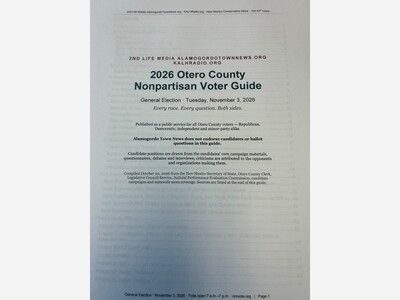

an impressive guide, that shows the balance needed to be fair to all.



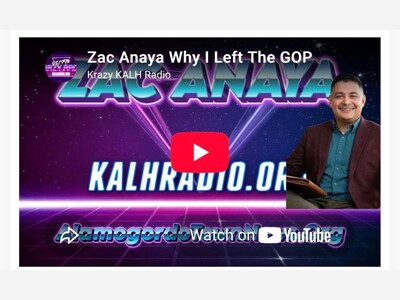
He did the same thing when he ran against Rachel. He's a pathological liar who just keeps proving it over and over.
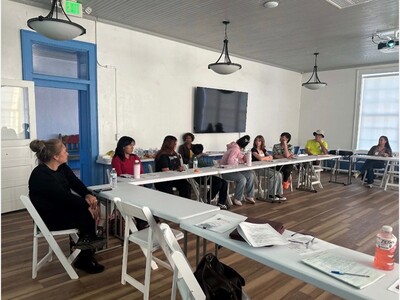
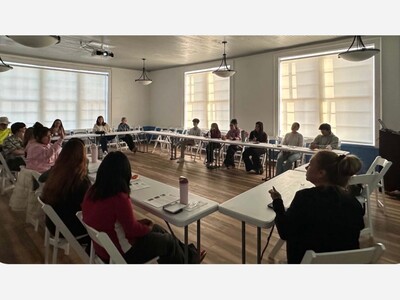
there is our future, kudos to both the students and the organizers.
Sounds overblown by the reporting of this party. On base we have something like this, but it's training leaders. Pic is a few kids with some volunteers who act to shape their opinions. If the schools were good enough the kids would learns this in a classroom.
Glad to hear that the base has a youth group. Now kids in Alamo, with no way to join that group, can also have a group where they can openly discuss their concerns, experiences, and work together to present solutions.
and, no, a PhD didn’t come up with this program. A very smart, educated woman suggested it.
the problems facing the republican party of new mexico pale in comparison with those of their national party - as the old saying - Meaning: Problems in an organization or society start at the top, with its leaders.
The fish rots from the head down
True. A prime example of this was the DNC failures in the 2020 election.
I have voted Republican in the past, but not this time. Our church group knows a few people who have tried to run or get involved and the old school fools won't let anyone they don't know get in at all. You can't solve any problem with the same people who created it. That's why we have terrible doctors here.