


Image
Note: This is story is updated (Oct. 20, 2026) with clarifications from the National Science Foundation.
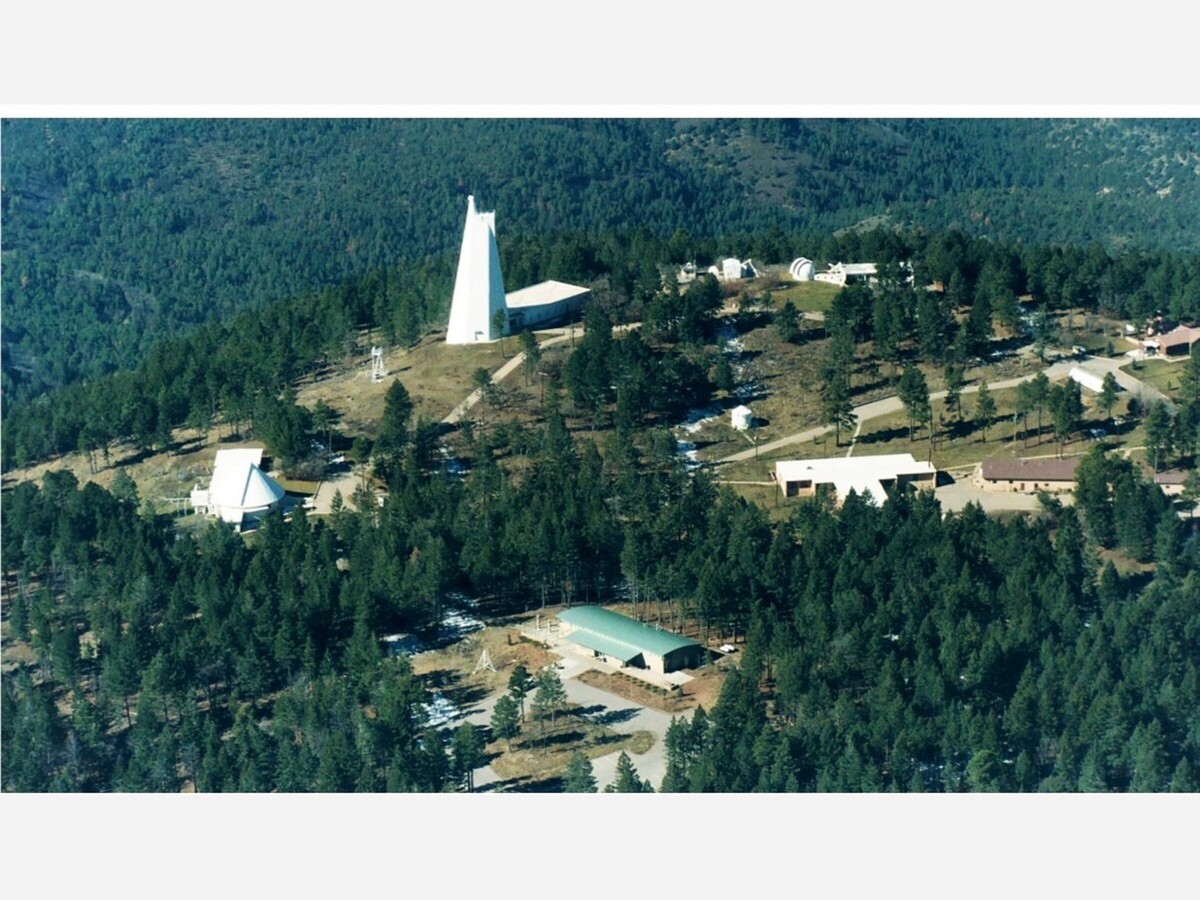
The Dunn Solar Telescope will be demolished by spring of 2027 and Sunspot Solar Observatory will be gone by Christmas 2027, the National Science Foundation and the U.S. Forest Service announced Monday, Oct. 19.
NSF has also published an unredacted version of the “Justification for Other Than Full and Open Competition” in awarding the demolition contract to Thornton Tomasetti.
The complete schedule for demolition is:
October–December, 2026: Scaffolding constructed around DST; removal of the concrete structure begins from the top down.
January–March 2027: Concrete and interior structures removed; DST demolition to ground level complete; site clean-up and demobilization. Procurement and Phase 1 task order award for Sacramento Peak site demolition. This matches the Sept. 23, 2026–March 23, 2027 time frame for the $10 million contract awarded last month to Thornton Tomasetti.
April–September 2027: Phase 1 implementation, “removing structures that have been unused for extended periods.” Phase 2 contract award.
October–December 2027: Phase 2 “will focus on removal of all other structures on site.”
Mike England, NSF head of media affairs, wrote that he could not confirm which structures were in Phases 1 vs. 2, and “[is] not able to speak to the status” of the post office, which is a privately owner building, or the fire/EMS station. NSF-owned structures slated for demolition include the Evans Solar Facility, Hilltop (Patrol) Dome and lab, the main lab, machine shop, community center, 16 houses, the dormitory, visitor center, and various support facilities.
NSF’s land use agreement with the U.S. Forest Service requires that NSF remove all manmade structures to a depth of four feet and refill with approved soil. England wrote that NSF “is coordinating with the USDA Forest Service on leaving the site in the best possible condition to support their plans for future use as those evolve.” This includes discussions with the Apache Point Observatory about maintaining the water supply.
Work begins with an assessment of other hazardous materials — asbestos, lead-based pain, lead-bearing plumbing, and polychlorinated biphenyls (PCB) — that were common construction materials during the 1950s and ‘60s when Sunspot was built and expanded. NSF will work with the New Mexico Environment Department on removal and safe disposal.
“Where feasible, contractors will also work to identify instruments and equipment inside the telescope that can be safely retrieved and decontaminated for continued scientific or educational use,” the NSF stated. This is contrary to an earlier statement that no further instrument removal would be permitted.
On Sept. 29, NSF reposted the unredacted announcement of the demolition contract “for 30 days to correct inadvertent redactions in the previously posted version.” The major revelation was the estimated total value of $20 million. That is $6.7 million greater than the three awards made to date:
Original award (3/23/2026,), $310,000, to assess the situation and later increased to $670,679 to cover purchase of long-lead items,
Second award (7/10/2026), $3, 071,489, to remove mercury, and
Third award (9/23/2026), 9,999,334, to demolish the Dunn.
England wrote that what appears to be three separate contracts are “are task orders issued against the same Indefinite Delivery/Indefinite Quantity (IDIQ) contract,” and that the $20 million “represents a ceiling, not a guaranteed amount.” No extensions are planned.
This story will be updated when new information is available.



just like the old fram oil filter commercials, timberon is experiencing a pay me now - or pay me later revelation. the longer they wait, the more they will pay - at this point receivership looks like the only real option.

Sunny, with a high of 60 and low of 43 degrees. Sunny for the morning, clear during the afternoon and evening,


Isn't disagreement about ******* legal?
I think it's Rardin, not Riordin




re-arranging the deck chairs on the titanic?