
 69° and Light drizzle



Image
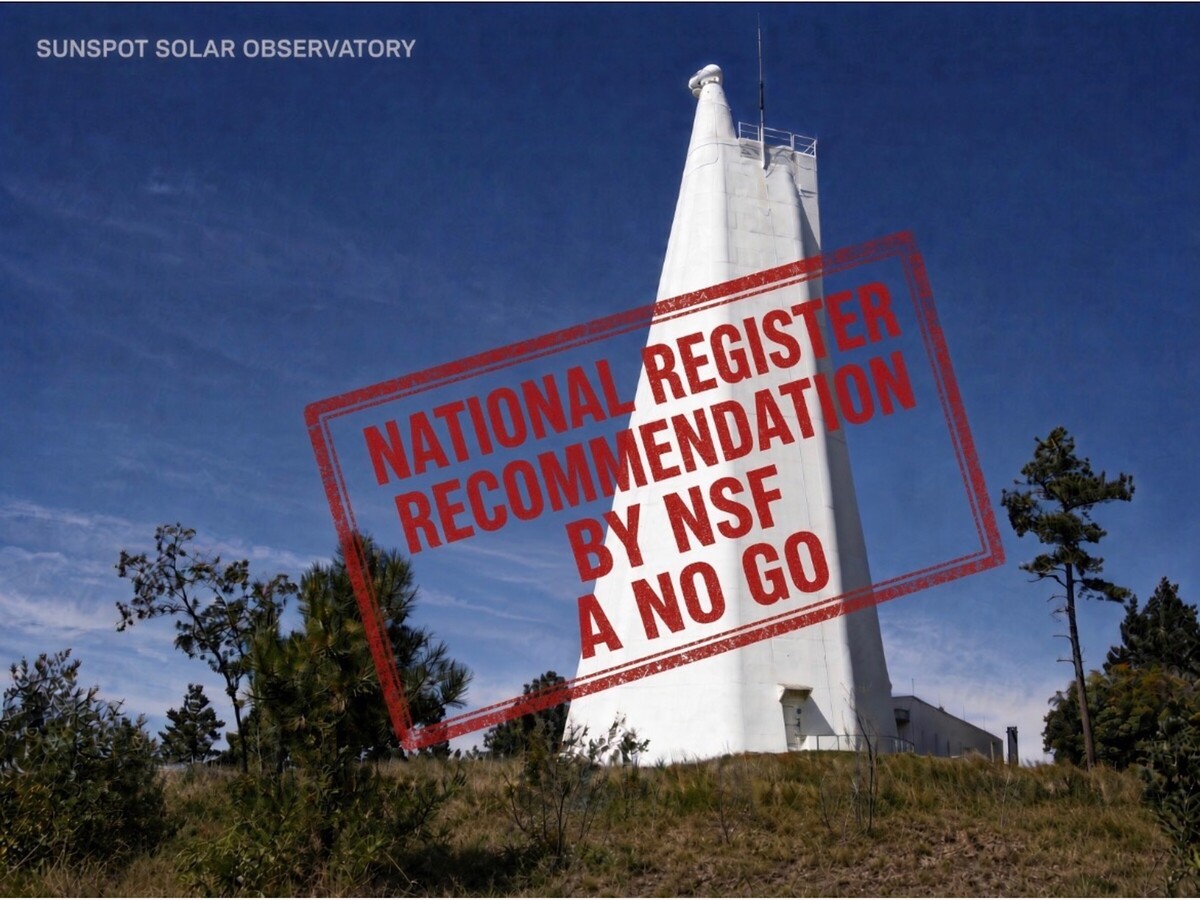
The National Science Foundation says it will not apply to add Sunspot Solar Observatory to the National Register of Historic Places even though it filled out the paperwork.
“NSF recognizes the historic significance of the observatory and appreciates your interest in its future,” Dr. Linnea Avallone, NSF Chief Officer for Research Facilities, wrote on Wednesday, Oct. 14. “However, after considering the request in the context of NSF’s existing decisions and obligations, NSF does not intend to pursue formal listing of the property on the National Register.”
Avallone’s e-mail was sent to Ricardo St. Hilaire an attorney who specializes in cultural affairs and an avid amateur solar astronomer, in reponse to St. Hilaire’s Oct. 6 “formal request asking NSF to move forward with the National Register of Historic Places nomination for the Sacramento Peak Observatory Historic District. As explained in the request, NSF completed the National Register documentation in February 2020. It is respectfully requested that NSF now take the remaining steps to move the nomination through the federal process.
“Listing Sunspot Solar Observatory/Sacramento Peak Observatory on the National Register provides significant advantages to all stakeholders. For NSF, in particular, listing would provide a recognized framework for managing the historic campus, facilitate potential reuse, build partnerships, and help cultivate options for the property's future disposition.”
Sunspot’s history dates from 1947 when two Air Force observers set up camp with a single telescope at Sacramento Peak to check seeing conditions. Over the next 30 years, Sunspot grew from early space weather forecasting station to a world leader in studying the Sun to understand better how it affects us on Earth. A 1976 change in defense funding forced the Air Force to plan its shut down. But, the NSF responded to the world science community and took over.
In the late 1990s, NSF started planning what is now the 4-meter (13-ft) aperture Daniel K. Inouye Solar Telescope atop Maui. Its development and operation costs forced NSF to plan “divestment” in hopes that a team would emerge to take over. New Mexico State University had operated the Dunn Solar Telescope for several years until Jan. 6 when a mercury leak in its main bearing forced its shutdown.
During 2016–20, NSF held environmental impact hearings in Alamogordo and then published its final decision of record. Of four alternatives — 1) operations as-is, 2) partnership, 3) mothball while looking for options, and 4) total demolition and remediation — NSF chose 1 and 4.
“As reflected in NSF’s February 2026 update, no parties presented viable plans that provide full financial support for continued observatory operations or assume ownership of the telescope or observatory,” Avallone wrote. “NSF therefore proceeded with implementation of Alternative 4, consistent with the 2019 Record of Decision. It would not be typical for a federal agency to nominate a facility that is slated for demolition to the National Register; in fact, listed properties are typically delisted after such a loss of historic integrity. NSF therefore does not intend to initiate the nomination process.”
NSF also has resisted efforts by Sunspot Community Center and others to implement Alternative 3 for the remainder of the site and allow time to develop a plan and seek funding.
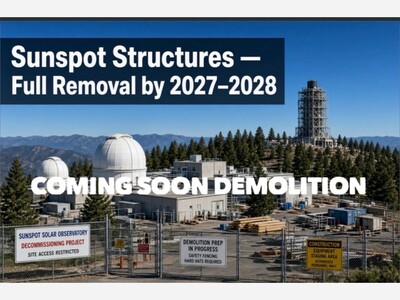
Given this position, it appears likely that NSF plans to proceed with total demolition and remediation, making it difficult for supports to secure any kind of commitment. The current $9,999,334 contract with Thronton Tomasetti to destroy the Dunn — $666 short of the $10 million reporting threshold under the Federal Truth in Negotiations Act — runs Sept. 23, 2026–March 23, 2027. NSF has declined to comment on plans to request proposals or a timetable for the remainder of Sunspot. The previous contracts to remove the mercury and demolish were sole-source, unadvertised, and categorized as “Controlled, unclassified information,” and therefore outside Freedom of Information Act disclosure.
NSF will not let Sunspot be forgotten. It promised $100,000 for an interpretive exhibit. That is about 500 square feet (about 22x22 ft) at quoted average costs of $200/square foot. Meanwhile, it has spent $5 million of a science center at the collapsed Arecibo radio telescope in Puerto Rico and $4.5 million to build a science center inside the decommissioned McMath-Pierce Solar Telescope at Kitt Peak (AZ) National Observatory.

I follow theatres across the county, and know, this report is very sparse with details. Impossilbe to spend a million dollars on removing a fly loft, rigging and weights. New roof . . other upgrades, no where near a million bucks. The defamation should be on the managers who awarded inexperienced developers.

2nd Life Media is not an owner. We sold our share and that owner sold it to the present owner. Might want to check your facts. Also LEDA requires receipts and documentation. We had an estimated when we were an owner of aproximately $3 million needed to make it operational. Check your facts.
It will take well over a million dollars to make the theater usable to the public. We have not yet spent a million dollars, but we are far from complete. Our projected open date is Summer/Fall 2027.


Sunny, with a high of 73 and low of 55 degrees. Clear during the morning, patchy rain nearby in the afternoon, overcast in the evening, clear overnight.




another useful example of a politician who is financed almost completely by special interests rather than the folks he's supposed to be representing. he represents the interests of those who pay his way...and only appeals to his voters when it comes time for re-election.


For those of the civilian public to understand. Every single Airman, marine, sailor and soldier whether Active duty or reserve or national guard has had explicit training on the UCMJ and illegal orders. This includes every “veteran for peace” It is political plain and simple.
regrettably, it might be necessary in the days of numerous respected/high ranking/decorated military leaders being fired/demoted/forced into early retirements when they fail to meet the specifications of glorious generalissimo hairgel - grapevine seems to indicate that dear leader is tiring of his various antics - e

Received that crime flyer in the mail today. Wow! Mudslinging V2.0 by the blockheads as usual.