63° and Overcast
Image
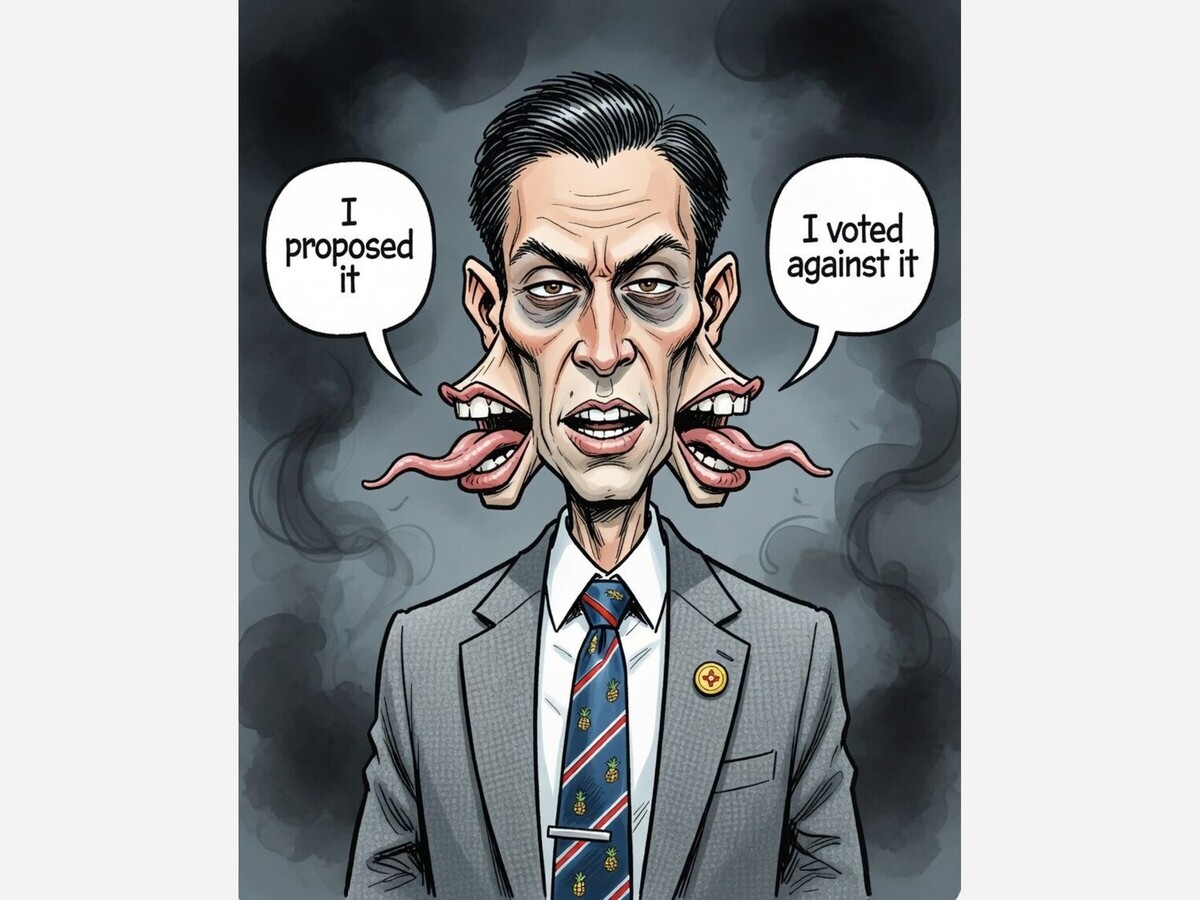
Parody Legislators Talking out of both sides of their mouth in New Mexico



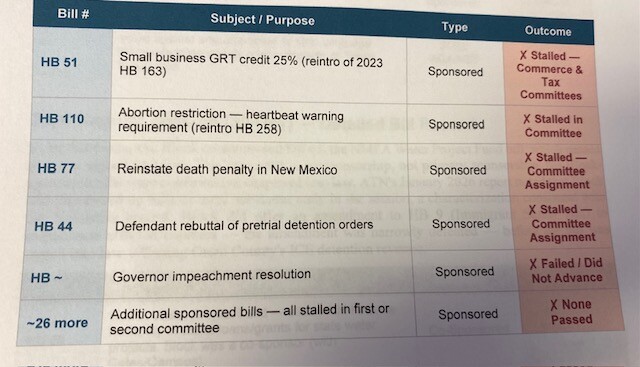
Four years. Four sessions. 53 bills introduced. 3 signed into law. A NAY vote on $14.25 million for Otero County — then a press release claiming credit. Here is how the process works, why his claims do not hold up, and what the official record shows, session by session.
ALAMOGORDO, NM — State Representative John Block has told voters in District 51, in press releases, on social media, and on his own Piñon Post website, that he has fought hard to bring money back to Otero County. It is a central pillar of how he presents himself to the people he represents.
There is a problem with that claim. And it is not a matter of opinion or political disagreement. It is a matter of how the New Mexico legislative process actually works — and what the official roll call votes actually show.
Block requests project funding for his district. Then he votes against the bill that authorizes and delivers that funding. Then he issues a press release taking credit for the money that arrives anyway, carried to Otero County by the votes of legislators who did not abstain or oppose.
To understand why this matters — and why it is disingenuous rather than merely a political position — you first need to understand exactly how capital outlay funding works in New Mexico. Because the process itself makes the contradiction inescapable.
He fills out the request form. He attends the meetings. He puts the projects in the bill. Then he votes no on the bill. Then he holds a press conference about the money that just came to his district.
How New Mexico Capital Outlay Actually Works: A Plain-Language Guide
Capital outlay money is the state funding that builds and repairs the physical things communities depend on: roads, water systems, school buildings, fire stations, animal shelters, recreational facilities, and public safety equipment. In New Mexico, this money flows from the state to counties and municipalities through a specific, well-documented process governed by the Legislative Council Service, the Department of Finance and Administration, and the Governor's Office.
Here is how that process works, step by step, every single year:
STEP 1: Community Requests Come In Before the Session
Before each legislative session, local governments, school boards, municipalities, and community organizations submit their infrastructure needs to their state legislators. City of Alamogordo officials, Otero County commissioners, NMSU Alamogordo administrators, the School for the Blind and Visually Impaired — they all sit down with their representative and explain what projects they need funded. Representative Block participates in these meetings. He collects these requests. This part he does.
STEP 2: The Legislator Fills Out a Capital Outlay Request Form
Each legislator submits a Capital Outlay Request Form to the Legislative Council Service (LCS), the nonpartisan drafting agency of the New Mexico Legislature. The form requires the project name, description, location, ownership, and cost. The LCS assigns each project a tracking number and compiles all requests into a master spreadsheet. By law, individual legislators' funding allocations remain confidential until 30 days after the session ends. Representative Block fills out these forms. He submits these requests. This part he also does.
STEP 3: The Total Pot Is Divided Among the Governor, Senate, and House
The available capital outlay money — sourced from severance tax bonds, general obligation bonds, and general fund revenue — is divided roughly equally between the Governor's Office, the New Mexico Senate, and the New Mexico House of Representatives. The House share is then subdivided among all 70 House members. Each representative gets an allocation to apply toward the projects they submitted. In recent years, each House member's share has ranged from a few hundred thousand dollars to several million, depending on the state's fiscal condition.
STEP 4: Legislators Coordinate in Regional Working Groups
Representatives and senators from the same geographic area — like the Otero County delegation — typically form working groups to coordinate their allocations, combine resources on large projects, and try to fully fund as many community priorities as possible. Senator William Burt, Senator Ron Griggs, Senator Pat Pirtle, and Representative Willie Madrid have all participated in this coordination for Otero County projects in recent sessions. This regional coordination is how a project like the Alameda Park and Zoo or the Tularosa water system gets fully funded — multiple legislators pooling their allocations. Block participates in some of this coordination, at least in some years.
STEP 5: All Approved Projects Are Written Into a Single Bill
Every project approved by every legislator and the Governor is listed in a single omnibus capital outlay bill. In 2023, that was House Bill 505. In 2026, it was Senate Bill 240. This is the bill that, if passed and signed by the Governor, legally authorizes and appropriates every dollar for every project in the state. Without this bill passing, no project — including every one submitted by Block for Otero County — receives a single cent. There is no alternative mechanism. There is no other vehicle. If this bill fails, the zoo does not get funded. The water system does not get repaired. The police vehicles do not get purchased. The money does not exist without this vote.
STEP 6: The Bill Comes to a Vote on the House Floor
The full House of Representatives votes on the capital outlay bill. This is where Representative Block's record diverges sharply from his public statements. Every other Otero County senator and representative — Democrats and Republicans alike — has voted yes on these bills. Block has voted no. In each session from 2023 through 2026, Block cast a NAY vote on the capital outlay or general budget bill that contained the district funding he had requested and would later claim credit for delivering.
STEP 7: The Governor Signs the Bill and the Money Is Released
After the bill passes both chambers, the Governor has 20 days to sign it or line-item veto specific projects. Once signed, the money is released to the administering agencies, which then work with the local entities on project execution. The projects Block requested — the ones his constituents see getting built — arrive in Otero County at this stage. They arrive because the bill passed despite Block's vote, carried by every other yes vote in both chambers.
That is the process. Every step of it is documented. Every step of it is public. And the critical point is this: Step 2 (submitting the request) and Step 6 (voting on the bill) are not separable. A legislator who submits project requests and then votes against the bill authorizing those projects has not brought money to their district. They have attempted to claim credit for a process they voted to stop.
Submitting a request form is not the same as delivering the money. Voting against the bill that authorizes the money, then claiming you delivered it, is not accurate. It is not a technicality. It is the core of the issue.
Session by Session: The Votes, the Money, and the Claims
With that process understood, here is what the official record shows for each of Block's four sessions. Where documented, we include what Otero County received, how Block voted, and what he said publicly afterward.
2023 SESSION Block's Vote: NAY on HB 505 (Capital Outlay Projects, Chapter 199 — signed Apr. 7, 2023)
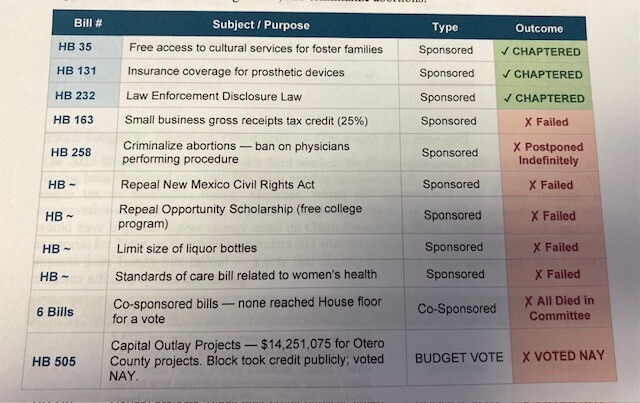
Otero County Funding in Bill: $14,251,075 total to Otero County projects
• $3,690,000 — Mescalero Apache Capital Projects
• $2,500,000 — City of Tularosa Water System Improvements
• $1,870,000 — NM School for the Blind and Visually Impaired
• $1,237,000 — Alameda Park and Zoo improvements, APD police vehicles, police infrastructure, golf course irrigation
• $1,000,000 — NMSU Alamogordo Campus Infrastructure
• Additional allocations to surrounding Otero County municipalities and agencies
Every Otero County senator voted YES: Burt (R), Griggs (R), Pirtle (R). Representative Willie Madrid (D) voted YES. John Block (R) voted NAY. He was the only Otero County legislator to oppose the bill. Within days of the Governor's signature, Block issued a press statement praising his leadership for bringing nearly $3 million back to his district. The total the district received was $14.25 million — delivered despite his opposition, not because of it. Per capita, Otero County received $207.93 per resident, compared to $308 per resident in Bernalillo County — nearly 33% less — in part because Block's NAY vote does nothing to maximize the district's allocations.
2024 SESSION Block's Vote: NAY on the General Appropriation Act of 2024 (10-billion-dollar state budget)
Otero County Funding in Bill: Budget funds multiple Otero County agencies, institutions, and infrastructure
• NMSU Alamogordo continued operating funding
• NM School for the Blind and Visually Impaired operating funding
• Otero County public safety and transportation infrastructure allocations
• State agency operations throughout Otero County including Holloman Air Force Base support services
Reporting confirmed that Block voted against the $10 billion state budget in 2024, making him the only Otero County representative or senator to oppose it. The Senate passed the budget 31-10. Senators Burt, Griggs, and Pirtle all voted YES. Representative Madrid voted YES. Block voted NAY. The budget contained funding for multiple projects and institutions within Alamogordo and Otero County. ATN reported at the time: 'The House leadership representing Otero County was split on its votes with Otero County Representative John Block voting AGAINST the budget and Representative Willie Madrid voted Yea for the budget that funds multiple projects and agencies within Alamogordo and Otero County.'
2025 SESSION Block's Vote: NAY on general budget and appropriations bills (60-day session)
Otero County Funding in Bill: Continued institutional and infrastructure funding for Otero County
• Source NM reported that Block co-secured $3 million for a Chaparral fire station facility in coordination with Rep. Sarah Silva (D-Las Cruces) and Sen. James Townsend (R-Artesia)
• NMSU Alamogordo and NM School for the Blind continued operating and capital funding
• Otero County infrastructure projects carried forward from prior authorizations
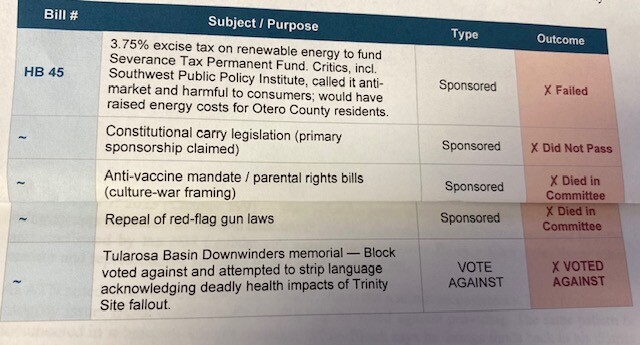
In 2025, Block did collaborate with other legislators on specific capital projects — the Chaparral fire facility funding being one documented example. This is the legitimate part of the process: legislators working together to direct their allocations. However, the pattern of voting against the final appropriations bill that authorizes all of this funding — including Block's own requests — continued in 2025. He voted Nay. Additionally, Block voted against a legislative memorial recognizing Tularosa Basin Downwinders and tried to strip the health-impact language from the resolution — a vote against recognition for Otero County residents who suffered documented health consequences from Trinity Site nuclear testing.
2026 SESSION Block's Vote: NAY on SB 240 ($1.25 billion Capital Outlay Bill — signed by Governor March 11, 2026)
Otero County Funding in Bill: SB 240 funded hundreds of state and local projects statewide, including Otero County
• Governor Lujan Grisham signed SB 240 and HB 248 (general obligation bonds), providing more than $1.5 billion for schools, roads, housing, and water conservation statewide
• Otero County received standard district allocations through SB 240
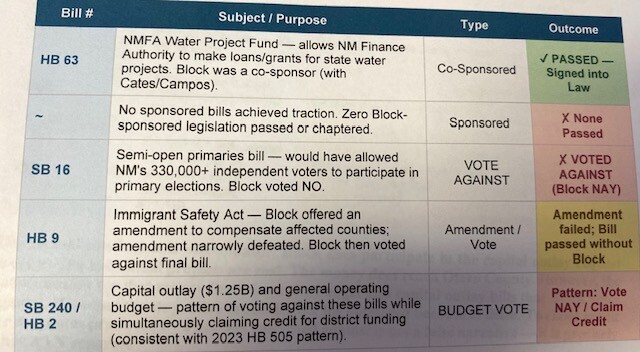
• Block co-sponsored HB 63 (NMFA Water Project Fund), which passed — his one documented co-sponsorship success of the session
In 2026, the capital outlay bill (SB 240) was signed into law on March 11, 2026. Block's documented pattern of voting against the authorization bill that delivers district funding continued.
A Comparison Worth Making: Block's Predecessor
Context matters. Before John Block, District 51 was represented by Rachael Black (R), whom Block defeated in the 2022 Republican primary. According to legislative reporting, Black's record in office produced more than $4.5 million in capital outlay for the City of Alamogordo and Otero County in 2021 and approximately $6 million in 2022 — funding that supported local infrastructure, law enforcement, and fire department projects.
Black's approach was straightforward: submit the requests, coordinate with the regional delegation, and vote yes on the bill that sends the money home. Block's approach has been to submit the requests, participate in coordination in some years, and then vote against the bill that sends the money home — while claiming the same credit Black earned by actually supporting the funding mechanism.
The distinction is not subtle. Voting yes on the capital outlay bill is how a legislator delivers for their district. Everything before that vote is preparation. The vote is the delivery.
Rachael Black delivered $4.5 million to Otero County in 2021 and $6 million in 2022 — by voting yes on the bills that authorized that funding. That is how it works. That is what Block refuses to do.
The Bottom Line for District 51 Voters
Representative Block is not a bad person for voting against the state budget on principle. There is a legitimate conservative argument that the state spends too much, that the budget is too large, that bond debt is fiscally irresponsible. Those are positions reasonable people hold.
But if you hold those positions, you do not get to then take credit for the spending those votes would have blocked. You do not get to issue a press release congratulating yourself for bringing $3 million to your district when you cast the vote that — had it prevailed — would have sent zero dollars to your district.
What Block has done, session after session, is have it both ways: vote with the fiscal conservative bloc to oppose the budget, then return home and claim the fiscal benefits of the bills he opposed. That is not principled conservatism. That is not fiscal restraint. It is a communications strategy built on the assumption that voters will not look up the roll call and that the press will not report on it due to threat of litigation from Block to expose the truth.
Alamogordo Town News looked it up the public is invited to look it up. The roll call is a public document. Every vote Block cast is a public record. Every project listed in HB 505 the recent funding bill is in the public record. Every dollar that came to Otero County despite his opposition is documented.
Three laws sponsored in four years created into law. A NAY vote on the capital outlay bill every single session. A press release after each session claiming credit for the funding he voted against.
That is the record. District 51 voters can look up the process and see for themselves that based on his budget appropriations vote vote he does NOT bring funds back to the district. Funds come to the district as a part of the process by submission of paperwork in spite of his vote against the funding by legislative decree as a part of the standard process. Has his votes prevailed zero dollars would have come back to the district.
SOURCES AND DOCUMENTATION
• New Mexico Legislature — Official Sponsor Records, Rep. John Block (SponCode: HBLOC): nmlegis.gov/Members/Legislator?SponCode=HBLOC
• NM Legislative Council Service — Capital Outlay Information Bulletin 2026 (Process Primer): nmlegis.gov/Publications/Info_Bulletins/2026/
• NM Department of Finance and Administration — Capital Outlay Bureau: nmdfa.state.nm.us/budget-division/capital-outlay-bureau/
• NM Governor's Office — Capital Outlay Request Process: governor.state.nm.us/request-capital-outlay/
• NM Secretary of State — Signed & Chaptered Bills 2023–2026: sos.nm.gov/legislation-and-lobbying/signed-chaptered-bills/
• NM HB505 (2023) — Capital Outlay Projects, Chapter 199, signed Apr. 7, 2023; Official Roll Call Vote, NM House of Representatives
• Alamogordo Town News — 'HB 505 Allocated $14 Million to Otero County, Block Voted NAY' (April 2023)
• Alamogordo Town News — 'NM Senate Passes $10 Billion State Budget' — Block the only Otero County rep to vote against (February 2024)
• Alamogordo Town News — 'Commentary: Has Block Delivered on Promises Made?' (January 2024)
• Alamogordo Town News — 'Rep. John Block's 2026 Session: Another Year of Invisibility' (January 2026)
• Source New Mexico — Legislative Recap March 13, 2025: Block, Silva, Townsend secure $3M for Chaparral fire facility
• Alamogordo Daily News / Yahoo News — 'Otero County Rep. John Block Introduced 30 Bills' (February 2024)
• NM Political Report — 'New Mexico's Capital Outlay Process' (February 2020) — process description confirmed against 2026 LCS bulletin
• NM Governor's Office — SB 240 and HB 248 signing statement (March 11, 2026): governor.state.nm.us
• Wikipedia — John Block (New Mexico Politician): en.wikipedia.org/wiki/John_Block_(New_Mexico_politician)

Awesome work! Now do Desperado Gabe Sanchez
With a Smokey-Mayor, we prove, once again, White Is Right, and we ain't going away for some race bullying.
What? Are you an imaginary person or just not brave enough to post this ******* comment under your real name? Probably the latter.


Overcast, with a high of 75 and low of 62 degrees. Overcast for the morning, patchy rain nearby in the afternoon, overcast for the evening,

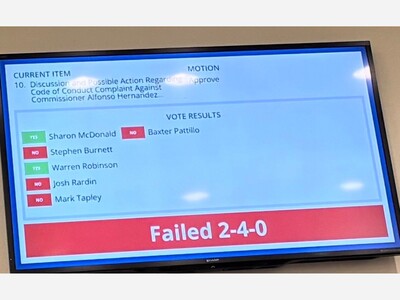
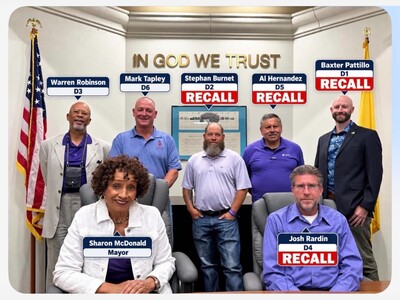
One more time, ATN gets it wrong. Now they have to find someone else besides Kim Night Owl Pampers to impeach the four commissioners ELECTED to run our city. Clearly, a landslide is coming, and the two rogue actors will be out.
and they'll be goosestepping right along - shades of ceausescu...
Valid point. However, dipsqueeze there probably cant figure out who that was and what you meant. He’s still trying to figure out why hot dogs arent made out of dog.


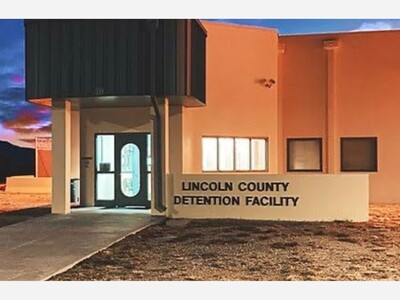
when jails and prisons are farmed out to operators who are in that business to turn a profit, it should come as no surprise when decisions are made that favor their profit over their legal requirements.
I am a firm believer that if the government takes away your rights and freedom, they should be responsible to incarcerate.