59° and Patchy rain nearby
Image



Alamogordo, NM (March 28, 2026) — The Republican Party of New Mexico (RPNM) remains embroiled in bitter internal division as State Chairwoman Amy Barela continues to defy party rules requiring her to vacate her leadership post while running in a contested Republican primary for Otero County Commission District 2. Multiple county Republican organizations, including Bernalillo, Sierra, and others, have issued open letters and public demands for her immediate resignation or temporary step-down, arguing that her refusal violates the party’s Uniform State Rules and creates an unfair advantage in the June 2, 2026 primary.
The controversy began on March 10, 2026, when Barela filed her candidacy paperwork at 9:06 a.m. Just two minutes later, Jonathan T. Emery, a longtime Otero County Sheriff’s Office deputy and IT specialist, filed as her Republican challenger. RPNM Uniform State Rule 1-4-4 states unequivocally: “In the event the state chairman or any other state officer of the Republican State Central Committee files as a candidate for public office and there is another Republican who has filed for the same office, the state officer shall immediately vacate the party office.” The rule contains no exceptions for incumbents, filing order, or timing.
Critics also point to ongoing optics issues, including a video posted on the official RPNM state platform featuring U.S. Senate write in candidate Larry Marker speaking in Otero County while wearing an Amy Barela campaign hat. Detractors say this constitutes a blatant use of party resources to promote Barela’s candidacy in violation of rules prohibiting endorsements or unequal treatment in contested primaries (Rules 1-4-2 and 1-4-3).
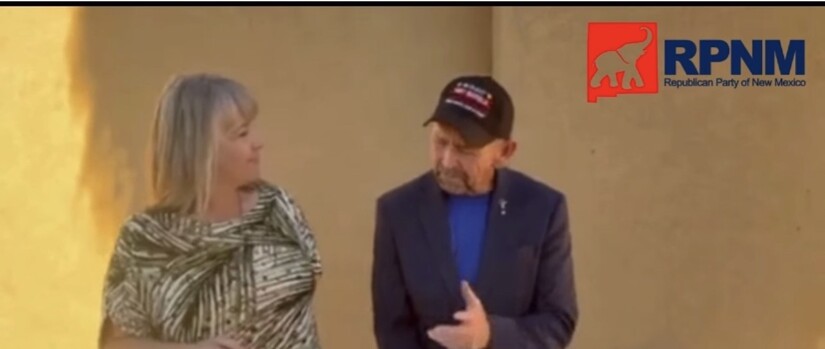 Senate Republican Candidates Wearing a Vote Amy Barela Hat on RPNM state party release- a flagrant disregard for use of state platform to favor Barela - AlamogordoTownNews.org
 State Senator James Townsend and other Barela supporters on the RPNM Executive Board have continued to back her position, defending her continued leadership and labeling county-level calls for resignation as “illegitimate” attempts to usurp the chairmanship. This stance, opponents argue, is eroding credibility among party leaders and deepening divisions at a time when Republicans should be unified ahead of the first-ever semi-open primary.
The state party has released a parliamentarian review conducted by Kay Allison Crews, a professional registered parliamentarian based in Dallas, claiming the rule only applies if another Republican filed before the state officer files. According to the RPNM Executive Board’s March 28 letter to the State Central Committee, this finding provides “no legitimate basis” to replace Barela. Critics maintain that the parliamentarian synopsis would not stand up to a legal challenge. The rule’s plain language triggers vacancy “in the event” a contested filing exists — regardless of who filed first or incumbent status. Introducing an unstated “first-to-file” or incumbent exception violates fundamental principles of contract and bylaw interpretation. RPNM’s Uniform State Rules were formally adopted and filed with the Secretary of State, giving them the force of governing documents among party members.
The RPNM Executive Board has repeatedly claimed it consulted “RNC legal counsel” (National Republican Party counsel) along with its own attorneys and the Advisory State Rules Committee. Yet that assertion has been questioned as false or misleading. National Republican Party leadership has claimed ignorance of the New Mexico infighting and has issued no official statement or formal finding on the Barela matter. Searches of public records and RNC communications and a call to the RNC headquarters reveal no endorsement, opinion, or involvement that would carry legal weight or shield the state party from internal challenge.
Legal precedents reinforce that ignoring such clear party rules can expose leaders to removal proceedings or court action. While political parties enjoy significant autonomy as private associations, adopted bylaws are binding, and courts have stepped in when internal violations affect candidate rights or public election processes. In particular, the U.S. Supreme Court’s landmark 1989 ruling in Eu v. San Francisco County Democratic Central Committee (489 U.S. 214) directly addresses similar disputes over party self-governance. In that San Francisco case, the Court struck down California election laws that restricted a political party’s governing bodies from endorsing candidates or stating their qualifications, ruling that such state interference violated the parties’ First Amendment rights of association. The unanimous decision emphasized that political parties have broad constitutional authority to control their own internal structures, bylaws, and processes free from undue external meddling — but they must adhere to the rules they themselves have adopted. Critics argue this precedent bolsters the position that RPNM’s own Uniform State Rules are enforceable and that the party’s current stance of creative reinterpretation could collapse under judicial review, potentially through a writ of mandamus forcing compliance with its filed bylaws
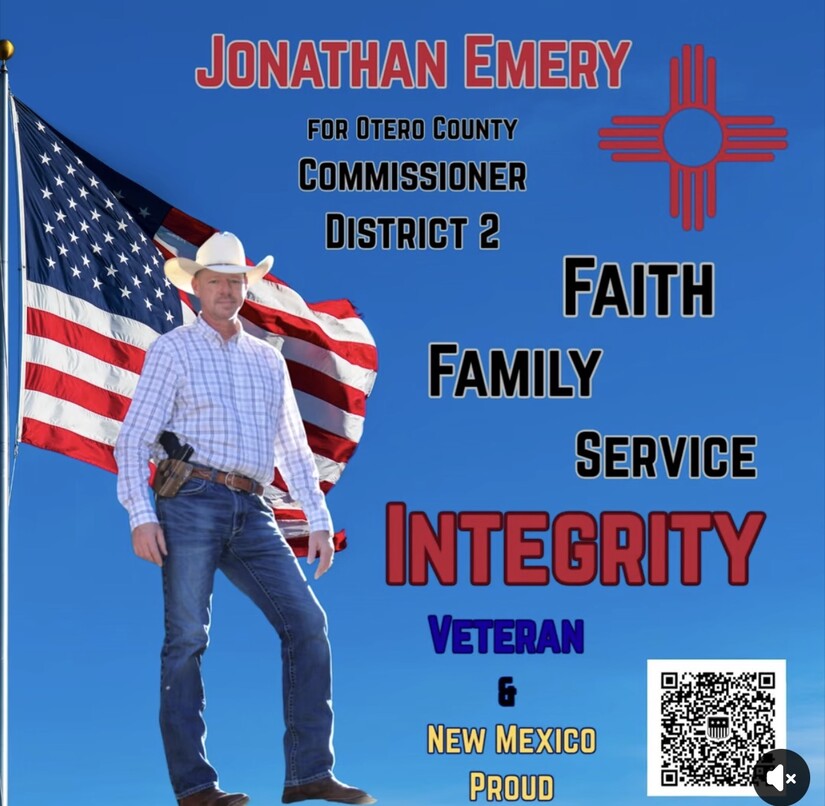
Barela’s opponent, Jonathan T. Emery, has now issued a detailed public statement addressing the mounting questions and pressure surrounding his candidacy. In the statement, Emery said: “After all the drama and noise, I guess I need to answer some of the questions I have received from not just you, but the press and other interested parties around the state and the country. No, I was not planted by anyone. No, I was not recruited to run against the incumbent by anyone. Once again this was a decision made between me and my wife some time ago. This internal battle in the party is not my battle, but it is affecting me and I have been dragged into it. I didn’t know I needed permission to run for an office. At the time of our decision that I chose to run for commissioner I was not even aware of the rule that is causing this upset and discontent. I did not make the decision to run for commissioner based on anyone in office. I made that decision based on what I have seen in our county and my ability and knowledge to bring something to the county. I have more to bring to the table other than my military and law enforcement experience but that’s for another post. I’m sure people have seen the post from various news articles. I have responded to most of them, just not on their timelines. There was a press release, corrections and answers to questions submitted. I have been threatened. I have been asked to reconsider, step down and/or withdrawal. I can tell you this. I have been in combat; I have been in law enforcement for 20 years. I will not bow to any man. I will not stop and I will not bow out. If I lose, then that’s Gods plan. I will be back for the 2030 race. If all this drama means I must support this campaign myself and fight the party I am a member of then so be it. I’m an American and we don’t quit when its necessary.”
As New Mexico prepares for its historic semi-open primary on June 2, 2026 — which will allow Decline-to-State and certain minor-party voters to participate in the Republican primary without switching registration — these divisions threaten to suppress turnout and damage Republican prospects. Early voting begins May 5.
Voters can review the semi-open primary rules through the League of Women Voters of New Mexico: https://www.lwvnm.org/information.php#semiopenprimary
Otero County voters with questions should contact the Otero County Clerk’s office.
The ongoing Republican Party dispute serves as a stark reminder that party rules exist to ensure fairness and neutrality in primaries — and selective enforcement risks further alienating the very voters Republicans need in November.
Regardless of the outcome the controversy is a textbook example of a party embroiled in a ethics crisis at it's highest level of leadership- placing power and advantage of optics of ethical behaviors.

Sunny, with a high of 77 and low of 59 degrees. Clear during the morning, patchy rain nearby in the afternoon, overcast for the evening, clear overnight.

there is our future, kudos to both the students and the organizers.
the problems facing the republican party of new mexico pale in comparison with those of their national party - as the old saying - Meaning: Problems in an organization or society start at the top, with its leaders.
The fish rots from the head down
True. A prime example of this was the DNC failures in the 2020 election.
I have voted Republican in the past, but not this time. Our church group knows a few people who have tried to run or get involved and the old school fools won't let anyone they don't know get in at all. You can't solve any problem with the same people who created it. That's why we have terrible doctors here.

when public utilities are taken private the ultimate goal is to generate profits for their investors - come on, ray charles could see that.
If they are truly public utilities, why do they charge?
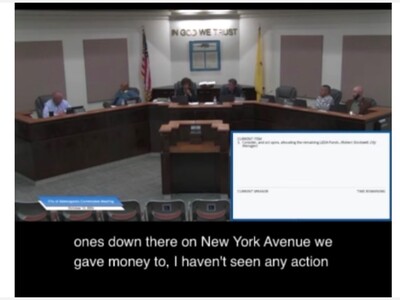
I follow theatres across the county, and know, this report is very sparse with details. Impossilbe to spend a million dollars on removing a fly loft, rigging and weights. New roof . . other upgrades, no where near a million bucks. The defamation should be on the managers who awarded inexperienced developers.
2nd Life Media is not an owner. We sold our share and that owner sold it to the present owner. Might want to check your facts. Also LEDA requires receipts and documentation. We had an estimated when we were an owner of aproximately $3 million needed to make it operational. Check your facts.
It will take well over a million dollars to make the theater usable to the public. We have not yet spent a million dollars, but we are far from complete. Our projected open date is Summer/Fall 2027.